





Order changes after production release
Compare a requested revision with material commitments and released work, obtain planner approval, and return the accepted change to the commercial team.
Explore workflows ↗ Salesforce
  HubSpot
  NetSuite
  Zendesk
  Microsoft Dynamics 365 Sales
  Dynamics 365 F&O
  Attio
Attio  Pipedrive
  Zoho CRM
  Campfire
  Rillet
  Front
Front  Shopify
  Amazon Seller Central
  SendGrid
 Manufacturing
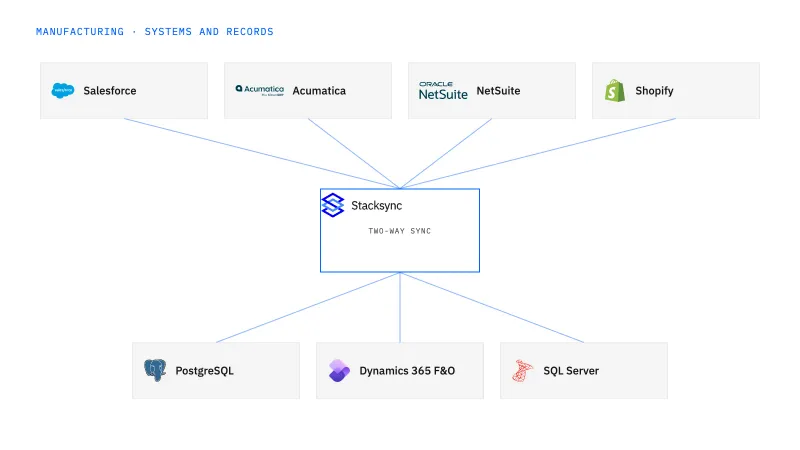
Two-way sync, workflow automation, Genies and EDI for manufacturers whose customer commitments depend on current production, purchasing and service records.
Sales, purchasing, production and service teams repeatedly copy the same order details while revisions and material constraints move ahead of their spreadsheets.
Explore your process in a demo, or get our shared two-way sync architecture guide.
The platform, in operating order
Keep shared customer, order, and operational records aligned, with clear field ownership.
Explore two-way sync 02Move approved work between systems, assign exceptions, and confirm the result.
Explore workflows 03Investigate cross-system questions, assemble the evidence, and prepare the next action.
Explore ai agents (genies) 04Connect trading-partner documents to operational records and exception handling.
Explore ediBuilt around your operations
US manufacturers with 100–1,000 employees combining production with distribution, aftermarket service or e-commerce.
Compare a requested revision with material commitments and released work, obtain planner approval, and return the accepted change to the commercial team.
Explore workflows ↗Connect missing components or service-part requests to the responsible purchasing, inventory and service owners before a new delivery promise is made.
Explore workflows ↗Read incoming order documents, assemble a proposed ERP order and ask people to resolve uncertain references or approval exceptions.
Explore Genies ↗Find your company type
Connect estimates, job revisions, outside processing and material evidence without turning a revised drawing into an unapproved shop-floor instruction.
Explore metal fabrication and machining ↗Keep tooling ownership, finished-goods availability, resin lots and molding changes connected across commercial and production systems.
Explore plastics and molding ↗Connect configured equipment orders, serial records, commissioning readiness and aftermarket service without hiding engineering or commercial approvals.
Explore industrial equipment and machinery ↗Connect dealer quotes, product variants, staged jobsite deliveries and returns across manufacturing, distribution and e-commerce.
Explore building products manufacturing ↗Keep customer program commitments, release schedules, lot records and engineering cutovers traceable across business systems.
Explore automotive components ↗Connect configured assemblies, revision-sensitive component stock, distributor orders and substitution decisions across operational systems.
Explore electrical and electronic components ↗Your systems and records
| Record | Owner | Operating rule |
|---|---|---|
| Customer and ship-to | Commercial operations | Match the sold-to account and physical delivery location separately; an account name is insufficient to choose a plant. |
| Order line and revision | Order management | Preserve the customer PO, source line identifier and approved revision across every receiving system. |
| Production commitment | Planning | Publish the approved quantity and promise date; a sales request must not silently overwrite released work. |
| Inventory eligibility | Inventory control | Distinguish physically present, allocated, quarantined and saleable stock before publishing availability. |
| Supplier confirmation | Purchasing | Keep the requested date separate from the supplier-confirmed date and the latest approved recovery plan. |
Keep 850 purchase orders and 860 buyer changes linked to a stable order identity, partner rules and an explicit production-release decision.
Implementation and operating guides
Manufacturers linking Salesforce and Acumatica need customer, ship-to and quote-revision identity resolved before order creation, with ERP acceptance flowing back per line.
Multi-plant manufacturers exposing Dynamics 365 Finance orders in SQL Server need company-scoped keys, line-level change capture and a separate route for any approved write back.
Before a storefront sells finished goods, decide which NetSuite stock counts as available, how Shopify boxes convert to base units and who owns the cross-reference.
Sales can read a NetSuite credit hold and shipment progress in Salesforce for the correct sold-to entity, while finance and order management keep the authority to change them.
Store each operation event beside its NetSuite order line in Postgres, derive readiness from the required evidence, and keep any ERP update behind a verified operation.
A field ownership matrix gives each order decision one owner, so a CRM edit becomes a request and a planning date, quality release or credit hold cannot be overwritten.
When a customer changes an order after release, the workflow snapshots the accepted revision, gathers material and job impact, and hands planning and finance a decision to approve.
A supplier-delay workflow keeps requested, confirmed and accepted dates apart, finds supply already on its way and prepares expedite or transfer options for the owner to approve.
A failed pump case moves from customer asset label to manufacturer serial, coverage ruling and approved replacement package, with separate sign-offs before the order is placed.
Instead of rekeying distributor PDFs, order intake gets a proposed NetSuite order with each value traced to the document or item master and unresolved lines held for a person.
Item identity, unit conversion, revision precedence and duplicate requests each get their own check, so a forwarded PO or an old pack description does not become accepted demand.
A document ledger and stable line mapping let a supplier tell an 850 replay from an 860 that cuts a line already in production, and answer the partner from accepted outcomes.
Choose one repeated handoff with an identifiable business record, an operational owner and a measurable backlog. A narrow customer-order or supplier-confirmation pilot is easier to evaluate than synchronizing every available field.
No. Data may move in both directions while ownership remains explicit. Sales can request a date; planning owns the accepted production promise; finance owns credit status.
A Genie can collect evidence, prepare updates and coordinate follow-up. Quality release, credit decisions, engineering changes and production commitments should follow the approvals defined by the manufacturer.
Bring one real process
Bring the systems, record types, and exceptions your team handles today. We’ll scope the connections and actions, then walk through the path to a confirmed result.
Explore your process in a demo, or get our shared two-way sync architecture guide.


