





Stacksync Enterprise Security SOC2 HIPAA Real Time Sync
Discover Stacksync's SOC 2 and HIPAA compliant real-time data sync platform, delivering enterprise-grade security for seamless, protected integrations.
- Author
- Ruben Burdin · Founder & CEO
- Published
- Updated
- Read time
- 7 min read

The challenge of securing enterprise data across multiple connected systems has intensified as organizations rely on an ever-expanding ecosystem of specialized platforms. Traditional data synchronization tools often treat security as an afterthought, creating vulnerabilities that scale with every additional system connection. This fundamental security gap forces organizations to choose between operational efficiency and enterprise-grade protection.
In today's interconnected enterprise environments, data synchronization platforms serve as critical infrastructure, moving sensitive information between CRMs, ERPs, databases, and other business-critical systems. This central role makes security not just a feature but a fundamental requirement. The stakes are particularly high when synchronizing customer data, financial records, and proprietary business information in real-time. A security vulnerability in your synchronization layer creates risk across your entire connected ecosystem.
The Stacksync Security Framework: Enterprise-Grade Protection by Design
Stacksync was built from the ground up with enterprise security requirements in mind. The platform addresses the critical security challenges that emerge when connecting operational systems through a comprehensive, multi-layered security architecture that maintains enterprise standards without compromising on performance or usability.
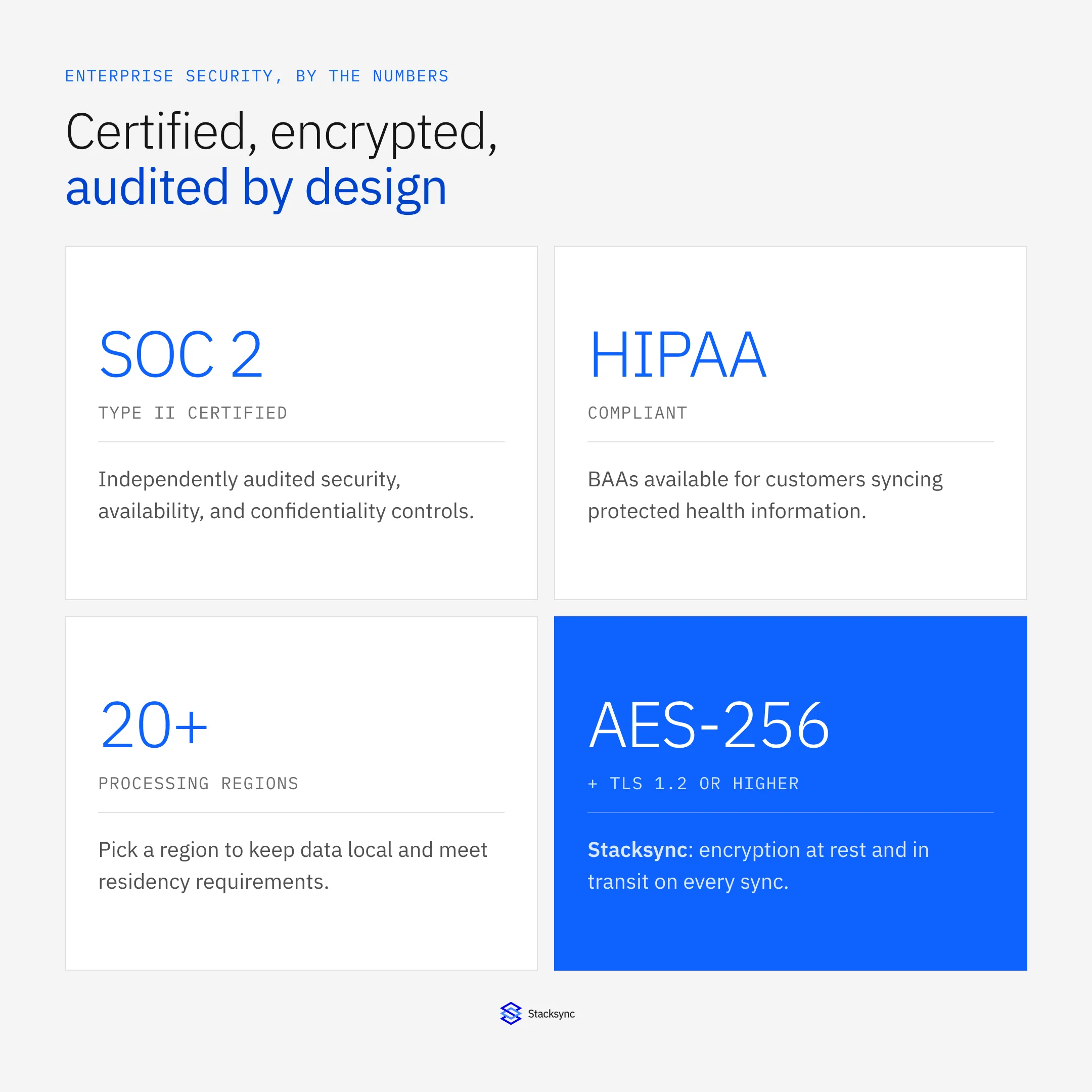
SOC 2 Type II Certification: Verified Security Controls
Stacksync has achieved SOC 2 Type II certification, verifying that the platform meets the American Institute of Certified Public Accountants (AICPA) criteria for managing customer data. This certification validates continuous adherence to security controls across five critical areas:
- Security: System protection against unauthorized access and disclosure
- Availability: Guaranteed system uptime meeting operational commitments
- Processing Integrity: Complete, accurate, and authorized system processing
- Confidentiality: Protection of information designated as confidential
- Privacy: Proper collection, use, retention, and disposal of personal information
SOC 2 is especially important for organizations that provide SaaS (Software as a Service) and cloud computing services. For enterprise data synchronization, this certification ensures that Stacksync meets the stringent operational and security requirements necessary for mission-critical integration infrastructure.
HIPAA Compliance: Healthcare-Ready Data Protection
Healthcare organizations and their business associates can leverage Stacksync's HIPAA-compliant infrastructure for synchronizing protected health information (PHI). The platform offers Business Associate Agreements (BAA) for HIPAA-regulated customers, maintains strong encryption for PHI during transit and processing, implements appropriate authentication and access controls, provides comprehensive audit logging for compliance reporting, and follows data retention best practices aligned with healthcare requirements.
HIPAA, or the Health Insurance Portability and Accountability Act, is US federal law that sets standards for the protection of sensitive patient data. It was enacted in 1996 with the primary objective to safeguard the confidentiality and integrity of patient health information, commonly known as PHI (Protected Health Information).
Additional Compliance Certifications
Beyond SOC 2 and HIPAA, Stacksync's comprehensive security framework is built on SOC 2 Type II, GDPR, HIPAA, and ISO 27001 compliance, providing the foundation needed to synchronize mission-critical data with confidence. This multi-certification approach ensures compliance across various regulatory requirements:
- GDPR: European data protection regulation compliance
- ISO 27001: International standard for information security management systems
- CCPA: California Consumer Privacy Act adherence
Multi-Layered Network Security Architecture
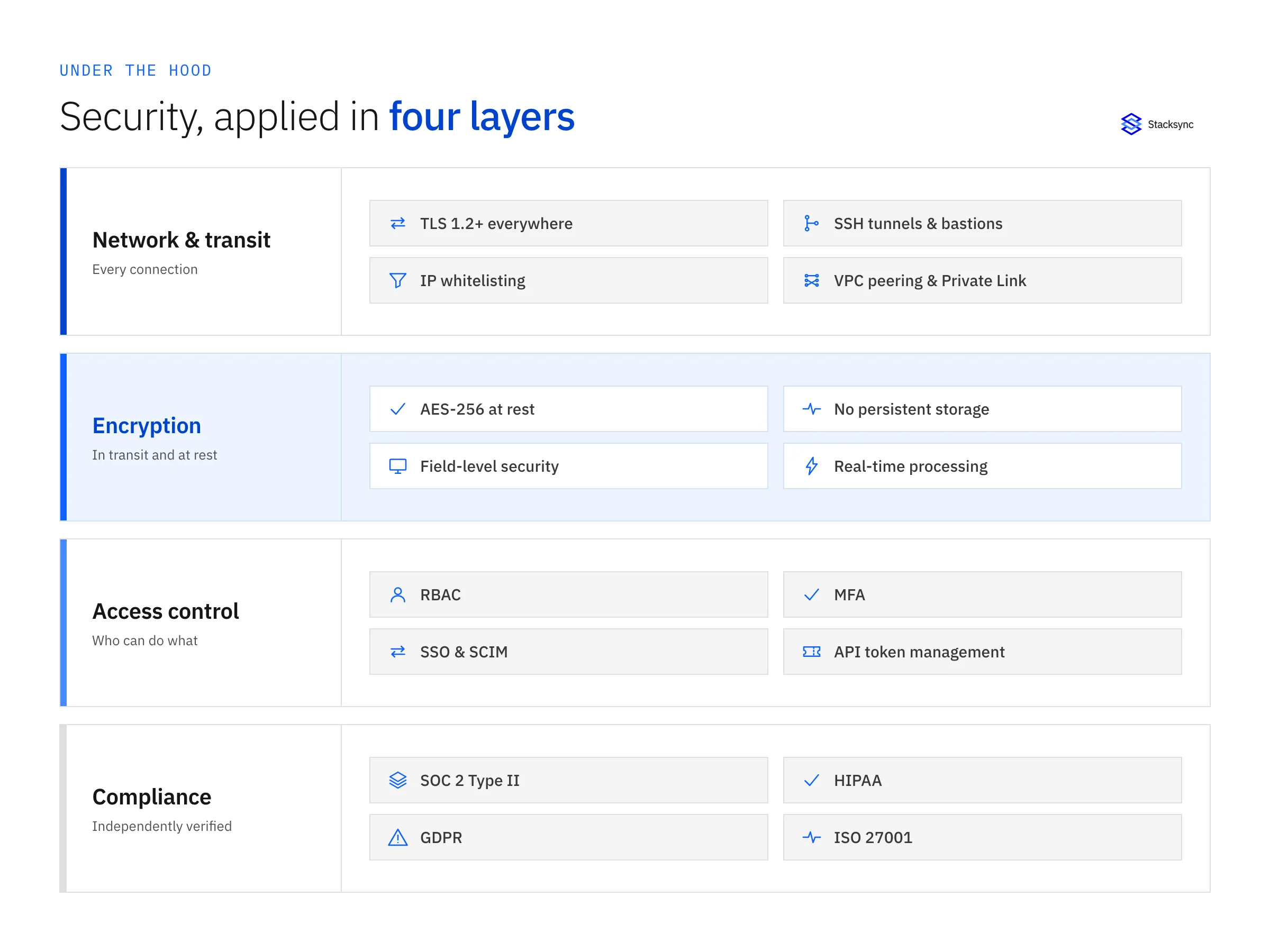
Stacksync implements comprehensive network security controls designed to protect data in transit and provide secure connectivity options for enterprise environments:
Secure Connection Methods
- OAuth 2.0: Industry-standard authorization for secure system connections
- SSH Tunneling: Encrypted connections through bastion hosts and jumpboxes
- SSL Certificates: Transport-layer security for all data transmissions
- IP Whitelisting: Network-level access controls limiting connection sources
Enterprise Network Integration
- VPC Peering: Direct, secure connections between cloud environments (AWS, GCP, Azure)
- VPN Gateways: High-availability encrypted tunnels for secure data transmission
- AWS Transit Gateway: Centralized connectivity hub for complex enterprise architectures
- Private Link: Dedicated network connections eliminating internet exposure
Advanced Access Controls
Stacksync provides sophisticated identity and access management capabilities:
- Role-Based Access Control (RBAC): Granular permissions based on organizational roles
- Multi-Factor Authentication (MFA): Additional security layers for user verification
- Single Sign-On (SSO) & SCIM: Centralized identity management integration
- API Token Management: Secure, auditable service-to-service authentication
Data Sovereignty and Regional Processing
Stacksync allows customers to choose from over 20 global processing regions, ensuring data sovereignty and compliance with local regulations. For EU operations, data processing can be restricted to European regions exclusively, eliminating cross-border data transfer concerns.
This geographic flexibility enables organizations to:
- Meet data residency requirements for regulated industries
- Optimize performance through regional processing
- Comply with local data protection laws
- Minimize latency for geographically distributed operations
Real-Time Encryption and Data Protection
The platform implements comprehensive encryption across all data states:
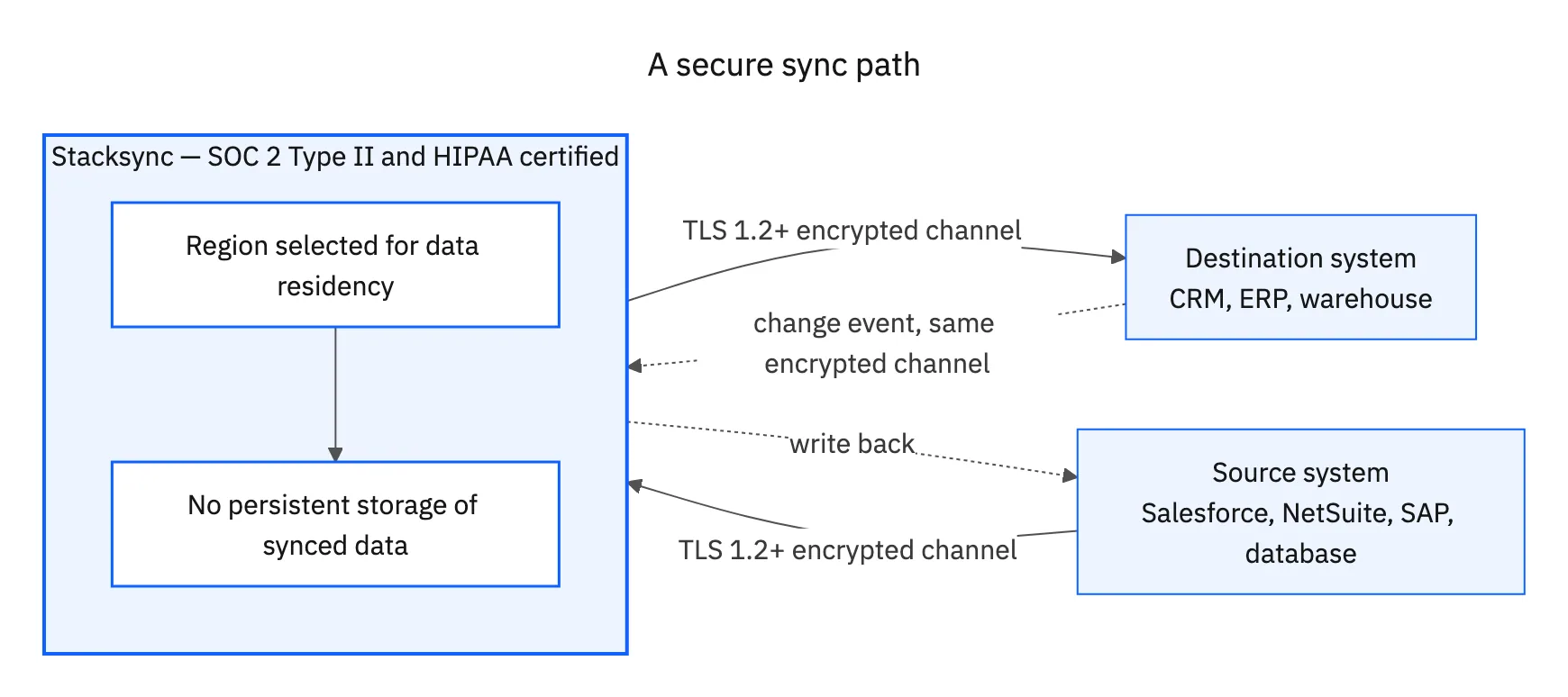
- Encryption in Transit: All data movement protected with industry-standard encryption protocols
- Field-Level Security: Granular protection for sensitive data elements
- No Data Retention: Data flows through the platform without persistent storage, reducing exposure risk
- Secure Processing: Real-time transformation and synchronization without compromising security
Security Monitoring and Incident Response
Stacksync provides enterprise-grade monitoring and alerting capabilities:
Comprehensive Logging and Audit Trails
- Detailed Activity Logs: Complete records of all synchronization activities
- Audit Trail Retention: Extended log retention periods for compliance requirements (up to 30 days for Enterprise customers)
- Security Event Monitoring: Real-time detection of potential security incidents
- Compliance Reporting: Automated generation of audit reports for regulatory requirements
Alerting and Notification Systems
- Multi-Channel Alerts: Notifications via email, Slack, WhatsApp, or PagerDuty
- Threshold-Based Monitoring: Customizable alerts for performance and security metrics
- Incident Escalation: Automated escalation procedures for critical security events
- 24/7 Support Hotline: Enterprise customers receive dedicated security incident response
The Operational Impact: ETL vs ELT vs Real-Time
Traditional data integration approaches create inherent security vulnerabilities through batch processing delays, temporary data storage, and complex transformation pipelines. Understanding these differences is critical for enterprise security planning:
ETL Security Limitations
Extract, Transform, Load processes require:
- Temporary storage of sensitive data during transformation
- Extended processing windows creating vulnerability exposure
- Complex transformation environments requiring additional security controls
- Batch processing delays preventing real-time security monitoring
ELT Security Challenges
Extract, Load, Transform approaches introduce:
- Raw data storage in target systems before security transformations
- Increased attack surface through multiple data copies
- Delayed application of security controls and data masking
- Complex access control management across storage and processing layers
Real-Time Synchronization Security Advantages
Stacksync's real-time, bidirectional synchronization provides superior security through:
- Minimal Data Exposure: Sub-second processing reduces vulnerability windows
- No Intermediate Storage: Data flows directly between systems without temporary storage
- Immediate Security Application: Security controls applied in real-time during data movement
- Continuous Monitoring: Real-time visibility into all data synchronization activities
- Instant Error Detection: Immediate identification and response to security incidents
The platform's multi-layered approach addresses security at every level, from encryption and authentication to network security and compliance. This enables mid-market and enterprise organizations to implement real-time, bidirectional synchronization without compromising on security requirements.

Secure Sync in Practice: Common ERP Use Cases
Enterprise security requirements are not abstract; they show up wherever regulated or financially sensitive data crosses system boundaries. ERP synchronization is one of the most common places this happens:
Sales and Finance Alignment
A "closed-won" deal in Salesforce or HubSpot automatically creates a customer and sales order in an ERP like NetSuite or SAP. When a payment is processed in the ERP, that status syncs back to the CRM, giving sales full visibility into payment status without switching applications, all under the same audit trail and access controls covering the rest of the sync.
E-commerce and Inventory Management
For online retailers, syncing Shopify with an ERP keeps inventory levels accurate across every sales channel the moment a product sells, preventing overselling and backorders without exposing inventory data outside the encrypted sync path.
Data Warehousing and Business Intelligence
Real-time sync from an ERP to a warehouse like Snowflake, BigQuery, or PostgreSQL gives teams up-to-the-minute reporting instead of last night's batch, while keeping the same SOC 2 and encryption guarantees in place for analytics workloads as for operational ones.
Implementation Security Best Practices
When implementing Stacksync for enterprise environments, organizations should follow these security best practices:
Environment Segregation
- Development/Staging/Production: Separate environments with distinct security controls
- Configuration as Code: Version-controlled security configurations
- Change Management: Formal processes for security configuration updates
Access Management
- Principle of Least Privilege: Minimal necessary permissions for each user and service
- Regular Access Reviews: Periodic validation of access permissions and requirements
- Service Account Management: Dedicated accounts for system-to-system authentication
Monitoring and Governance
- Continuous Security Monitoring: Real-time visibility into synchronization activities
- Regular Security Assessments: Periodic reviews of security controls and configurations
- Compliance Auditing: Regular validation of regulatory compliance requirements
By selecting a platform with enterprise-grade security built in, organizations can focus on deriving business value from synchronized data rather than worrying about potential security vulnerabilities in their integration layer.
Why Security-First Architecture Matters
The convergence of real-time data synchronization requirements with enterprise security standards represents a fundamental shift in integration architecture. Organizations can no longer accept the security compromises inherent in traditional integration approaches or the operational limitations of security-focused solutions that sacrifice performance.
Stacksync'ssecurity-first architecture demonstrates that enterprise-grade protection and real-time operational performance are not mutually exclusive. Through comprehensive compliance certifications, multi-layered security controls, and architectural choices that minimize data exposure, the platform enables organizations to achieve both operational agility and security assurance.
For technical teams evaluating enterprise synchronization solutions, security capabilities should be a primary selection criterion rather than an afterthought. The cost of security incidents, regulatory violations, and operational disruptions far exceeds the investment in purpose-built, security-first synchronization infrastructure.
Ready to experience enterprise-grade data synchronization with built-in security?
Contact Stacksync to schedule a security architecture review and discover how real-time, bidirectional synchronization can enhance both your operational efficiency and security posture.

FAQ
Frequently asked questions




Related articles


