





Workato Alternatives: Cut Costs & Sync in Real Time 2026
Compare the top Workato alternatives for 2026: real-time bi-directional sync, lower cost, and reliable CRM and ERP integration.
- Author
- Ruben Burdin · Founder & CEO
- Published
- Updated
- Read time
- 9 min read

Organizations increasingly struggle with complex data integration challenges as specialized business systems multiply across their technology stacks. The global data integration market size was estimated at USD 15.18 billion in 2026 and is projected to reach USD 30.27 billion by 2030, growing at a CAGR of 12.1% from 2026 to 2030, while another report projects growth from USD 17.58 billion in 2026 to USD 33.24 billion by 2030, at a CAGR of 13.6% during the forecast period. [1][2] This explosive growth reflects enterprises' urgent need for reliable data synchronization across CRMs, ERPs, and operational systems.
Traditional workflow automation platforms like Workato often fall short for organizations requiring true bi-directional synchronization with sub-second latency. While Workato excels at complex workflow orchestration, its data integration capabilities lack the real-time operational consistency that mission-critical systems demand.
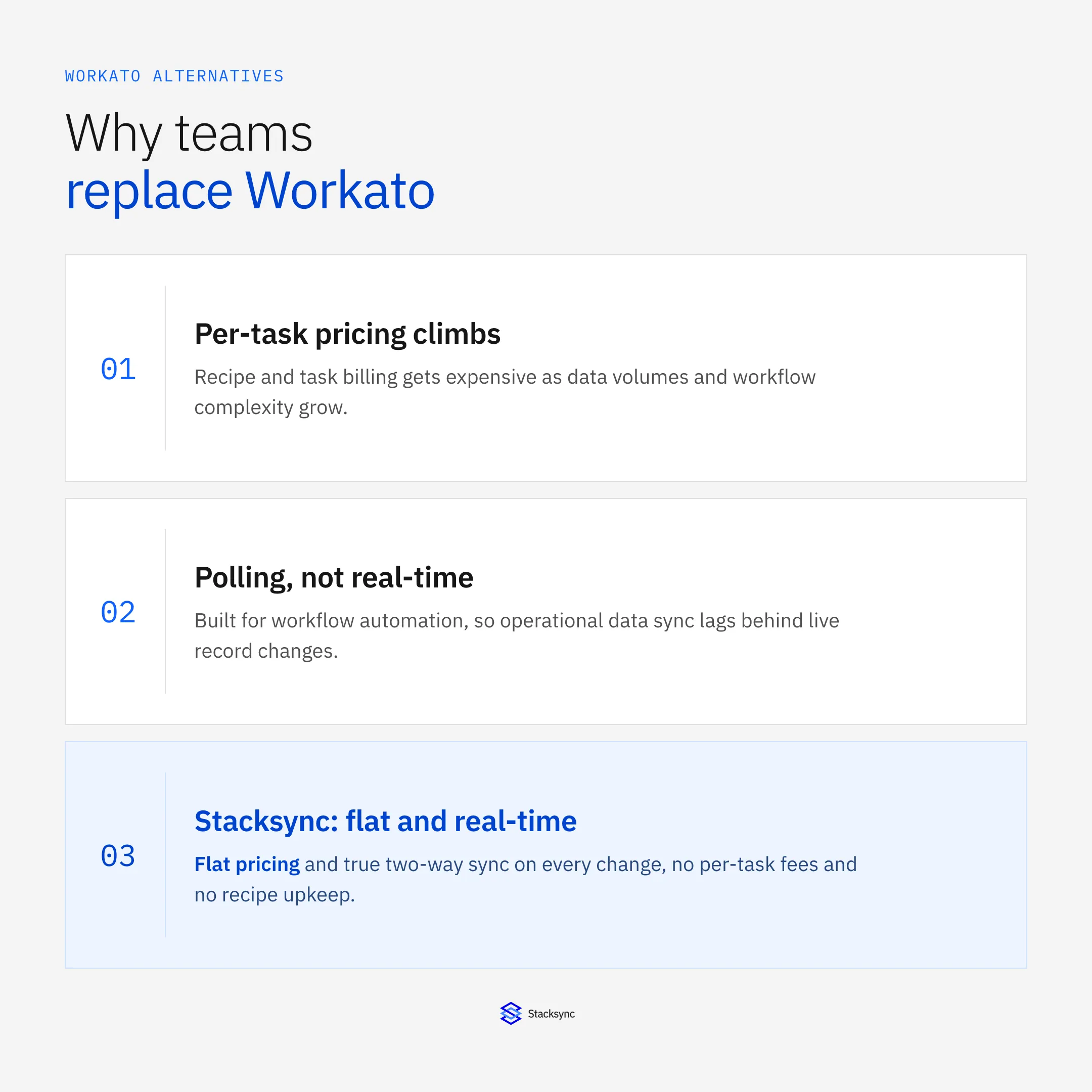
Why Consider Workato Alternatives?
Limited Real-Time Data Synchronization Capabilities
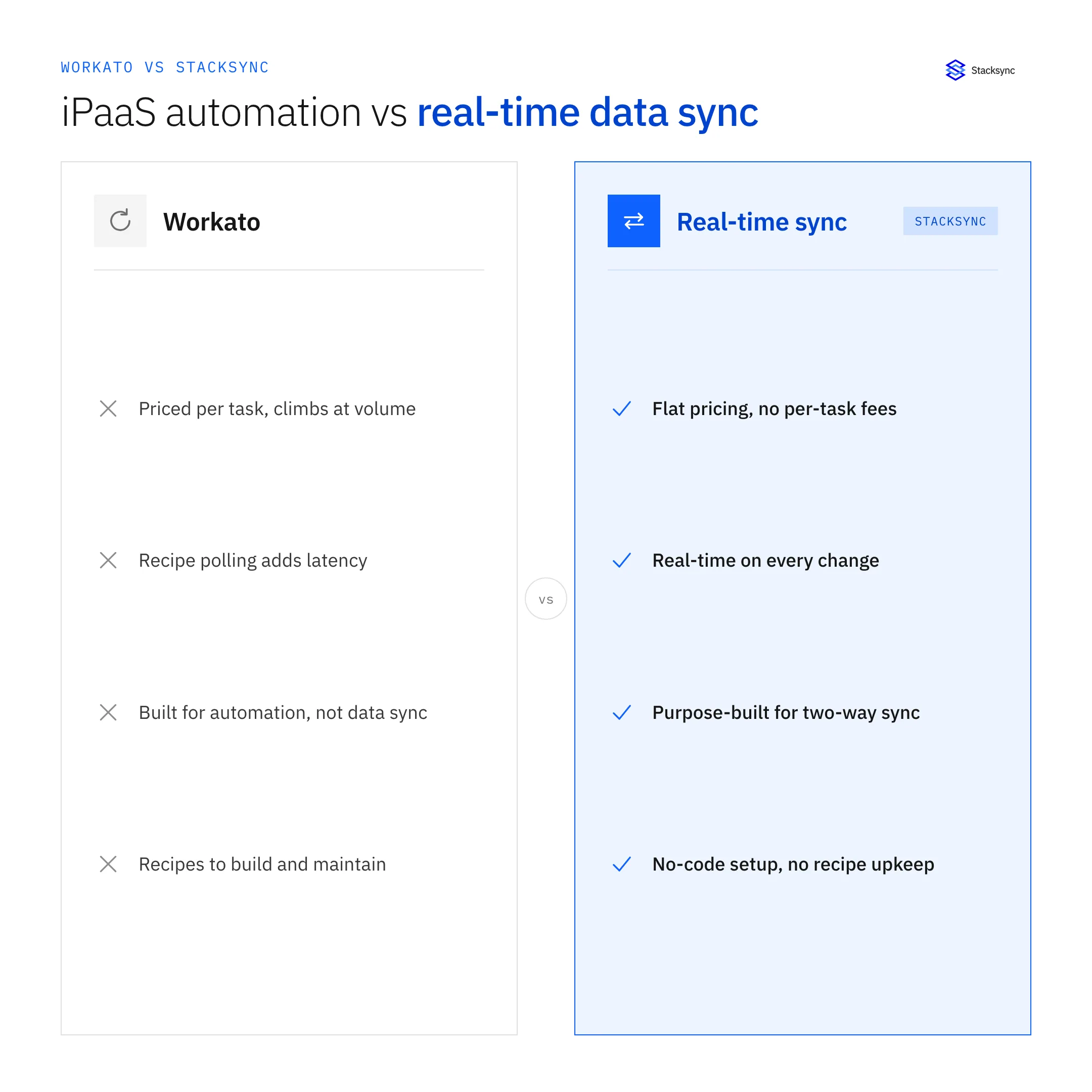
Workato's architecture prioritizes workflow automation over operational data consistency. Organizations requiring real-time, bi-directional synchronization between CRMs, ERPs, and databases face significant limitations:
- Batch-oriented processing introduces latency that prevents real-time decision making
- Complex configuration requirements demand specialized iPaaS expertise
- Limited bi-directional capabilities fail to maintain data consistency across operational systems
- High maintenance overhead diverts engineering resources from core product development
Expensive Implementation and Maintenance Costs
Workato's enterprise-focused pricing model creates financial barriers for mid-market organizations:
- Complex licensing structures with per-recipe pricing
- Extended implementation cycles requiring specialized consultants
- Ongoing maintenance costs that escalate with system complexity
- Limited cost predictability as data volumes and workflow complexity grow
Technical Architecture Limitations
Organizations with operational data synchronization requirements encounter specific technical constraints:
- No true bi-directional sync - relies on separate one-way flows that create consistency gaps
- API rate limit challenges without sophisticated handling mechanisms
- Limited database-centric architectures that prevent direct SQL access patterns
- Complex error handling requiring manual intervention for data inconsistencies
The Top Workato Alternatives
1. Stacksync - Real-Time Bi-Directional Synchronization

Stacksync powers real-time and two-way sync between CRMs, ERPs and Databases. Engineers use Stacksync to sync and consolidate data at scale, automate workflows and focus on what makes their business competitive, not dirty API plumbing.
Key Technical Capabilities:
- True Bi-Directional Synchronization: Use Stacksync to build real-time, bi-directional syncs, orchestrate workflows, and observe every data pipeline. Unlike platforms offering separate one-way flows, Stacksync provides genuine bi-directional sync with built-in conflict resolution.
- Sub-Second Latency: Features include sub-second latency, built-in conflict resolution, event queues, and developer empowerment through no-code/pro-code interfaces. Critical for operational systems where delays impact business processes.
- Extensive Connector Ecosystem: Supporting over 1,000 pre-built connectors, Stacksync integrates with CRMs, ERPs, databases, and SaaS applications, including Salesforce, NetSuite, HubSpot, and Snowflake.
- No-Code Implementation: Configure and sync data within minutes without code. Whether you sync 50k or 100M+ records, Stacksync handles all the dirty plumbing of infrastructure, queues and code so you don't have to.
Enterprise Security & Compliance:
- SOC 2 Type II, GDPR, HIPAA, and ISO 27001 certifications
- Data is encrypted in transit and at rest, and the platform offers strong access controls. Key Features: Role-based access control (RBAC), SSO, and processing region options for data sovereignty.
Best Use Cases:
- Operational data consistency across CRMs, ERPs, and databases
- Real-time customer data synchronization for logistics and energy companies
- Database-centric architectures requiring SQL access to business system data
- Organizations replacing expensive legacy tools like Heroku Connect
Customer Success Example: A logistics company like Acertus relies on Stacksync to synchronize data across Salesforce, Snowflake, and NetSuite, reducing manual effort and improving real-time visibility.
2. Microsoft Power Automate - Workflow-First Automation
Microsoft Power Automate focuses on workflow automation within the Microsoft ecosystem, providing strong process automation capabilities.
Key Features:
- Deep Microsoft Office and Dynamics 365 integration
- Built-in AI capabilities for intelligent workflow automation
- Robotic Process Automation (RPA) for legacy system integration
- Enterprise-grade governance and security controls
Best Use Cases:
- Organizations heavily invested in Microsoft technology stacks
- RPA scenarios requiring interaction with legacy applications
- Workflow automation with moderate data synchronization needs
- Department-level automation initiatives
Limitations:
- Limited real-time bi-directional synchronization capabilities
- Primarily workflow-oriented rather than data integration focused
- Constrained connector ecosystem outside Microsoft platforms
- Batch processing introduces latency for operational scenarios
3. Zapier - Simple App-to-App Integration
Zapier provides accessible automation for small to medium businesses requiring basic integration workflows.
Key Features:
- Extensive library of over 3,000 app connectors
- User-friendly interface for non-technical users
- Cost-effective pricing for simple automation scenarios
- Pre-built workflow templates for common use cases
Best Use Cases:
- Small business automation between SaaS applications
- Marketing workflow automation and lead management
- Basic CRM to marketing platform integrations
- Non-technical teams requiring simple trigger-action workflows
Limitations:
- No bi-directional synchronization capabilities
- Limited real-time processing - relies on polling mechanisms
- Restricted data transformation capabilities
- Not suitable for enterprise-scale operational systems
4. MuleSoft - Enterprise API Management Platform
MuleSoft provides comprehensive API management and integration capabilities designed for large enterprise environments. We break down the big iPaaS vendors in our MuleSoft vs Boomi vs Workato comparison.
Key Features:
- Strong API management and governance capabilities
- Enterprise-grade security and scalability
- Comprehensive connector library for enterprise systems
- Advanced data transformation and routing capabilities
Best Use Cases:
- Large enterprise API strategy implementations
- Complex multi-system integrations requiring sophisticated routing
- Organizations with dedicated integration teams
- Hybrid cloud and on-premises system integration
Limitations:
- High complexity requiring specialized expertise
- Extended implementation cycles and high costs
- Limited real-time bi-directional synchronization focus
- Overkill for mid-market operational data synchronization needs
5. Celigo - NetSuite-Focused Integration Platform
Celigo specializes in NetSuite integrations with broader iPaaS capabilities for mid-market organizations. See how it compares in our Celigo vs Boomi comparison, or read our full Celigo alternative breakdown.
Key Features:
- Strong NetSuite integration expertise and pre-built connectors
- Mid-market focused with reasonable pricing tiers
- Visual workflow builder for business users
- Specialized vertical solutions for common integration patterns
Best Use Cases:
- NetSuite-centric integration scenarios
- E-commerce to ERP data synchronization
- Mid-market organizations requiring NetSuite connectivity
- Vertical-specific integration requirements
Limitations:
- Limited real-time capabilities compared to specialized sync platforms
- NetSuite-centric architecture may constrain broader integration needs
- Traditional iPaaS limitations for operational data consistency
- Complex setup for true bi-directional synchronization requirements
Integration Platform Comparison
| Platform | Real-Time Sync | Bi-Directional | No-Code Setup | Enterprise Security | Best For |
|---|---|---|---|---|---|
| Stacksync | Sub-second latency | True bi-directional | Minutes setup | SOC 2, GDPR, HIPAA | Operational data consistency |
| Power Automate | Limited | Workflow-focused | Moderate complexity | Enterprise-grade | Microsoft ecosystems |
| Zapier | Polling-based | No | Simple interface | Standard | Small business automation |
| MuleSoft | API-dependent | Limited | High complexity | Enterprise-grade | Large enterprise API strategy |
| Celigo | Scheduled batches | Limited | Moderate | Mid-market focused | NetSuite-centric integrations |
Choosing the Right Workato Alternative
For Operational Data Consistency: Stacksync
Choose Stacksync when your organization requires:
- Real-time data synchronization between CRMs, ERPs, and databases
- True bi-directional sync maintaining consistent data across operational systems
- Minimal engineering overhead with no-code configuration and automated maintenance
- Enterprise security compliance for regulated industries
- Scalable architecture handling millions of records with sub-second latency
For mid-market companies seeking operational data consistency with minimal engineering overhead, platforms like Stacksync offer the best balance of capability and simplicity.
For Microsoft-Centric Workflows: Power Automate
Select Power Automate when:
- Your organization operates primarily within Microsoft's ecosystem
- Workflow automation takes precedence over data synchronization
- RPA capabilities are required for legacy system integration
- Department-level automation initiatives need enterprise governance
For Simple Business Automation: Zapier
Zapier works best for:
- Small businesses with basic integration requirements
- Non-technical teams requiring simple trigger-action workflows
- Cost-effective automation between popular SaaS applications
- Marketing and lead management workflow automation
For Enterprise API Strategy: MuleSoft
Choose MuleSoft when:
- Your organization requires comprehensive API management capabilities
- Complex enterprise-scale integrations span multiple systems and protocols
- Dedicated integration teams can manage sophisticated implementations
- API governance and lifecycle management are critical requirements
Cost Optimization Strategies
Organizations seeking cheaper Workato alternatives should evaluate:
Total Cost of Ownership Analysis
- Implementation costs: Stacksync's no-code setup reduces professional services requirements
- Maintenance overhead: Managed platforms eliminate ongoing infrastructure costs
- Engineering time savings: Connect all your systems saving 90% engineering time, no maintenance required.
- Scaling economics: Usage-based pricing models with volume discounts
Direct Cost Comparisons
- Stacksync: Tiered pricing starting at $1,000/month with transparent record-based scaling
- Workato: Complex recipe-based pricing often requiring enterprise negotiations
- Power Automate: Per-user licensing with flow limits and premium connector costs
- Zapier: Task-based pricing suitable for low-volume scenarios
Real-Time Data Synchronization Requirements
By application, the real-time data integration segment is anticipated to register the fastest growth rate during the forecast period. This momentum is driven by the increasing enterprise need for instant decision-making, operational agility, and responsive customer experiences. [2]
Technical Requirements for Real-Time Sync
- Event-driven architecture using change data capture (CDC) mechanisms
- Sub-second latency for mission-critical operational systems
- Automatic conflict resolution preventing data inconsistencies
- Reliable error handling with automated retry and rollback capabilities
Operational Benefits
- Elimination of manual data reconciliation processes
- Real-time visibility across integrated business systems
- Enhanced customer experience through consistent data
- Reduced operational risk from data consistency failures

Implementation Considerations
Technical Architecture Evaluation
Assess your integration requirements across these dimensions:
Data Flow Patterns:
- One-way analytics pipelines vs. bi-directional operational sync
- Batch processing tolerance vs. real-time operational requirements
- Event-driven vs. polling-based synchronization mechanisms
Scalability Requirements:
- Current and projected data volumes
- API rate limit handling and optimization
- Infrastructure management and maintenance preferences
Security and Compliance:
- Industry-specific compliance requirements (HIPAA, SOC 2, GDPR)
- Data sovereignty and regional processing needs
- Access control and governance requirements
Success Factors for Implementation
- Clear technical requirements definition before platform selection
- Proof of concept validation with representative data volumes
- Stakeholder alignment between IT, business, and compliance teams
- Change management planning for workflow and process modifications
Conclusion
The enterprise data integration landscape demands solutions that balance operational reliability with implementation simplicity. The wrong choice can result in brittle, high-latency pipelines, operational inefficiencies, and significant maintenance overhead that diverts engineering resources from core product development.
For organizations requiring real-time operational data consistency, Stacksync provides purpose-built bi-directional synchronization capabilities that eliminate the complexity and maintenance overhead of traditional iPaaS platforms. By solving the core problem of data consistency between CRMs, ERPs, and databases, platforms like Stacksync provide the stable foundation for all data-driven initiatives, from analytics to automation.
Traditional workflow automation platforms like Workato, while powerful for complex process orchestration, often fail to deliver the real-time operational synchronization that modern enterprises require. By selecting specialized tools designed for specific technical challenges, organizations can achieve better outcomes with lower complexity and reduced costs.
The key to successful integration platform selection lies in aligning technical capabilities with specific operational requirements, ensuring that your chosen solution provides the reliability, performance, and scalability needed to support critical business processes without constraining future growth.
Ready to keep your systems in sync and achieve true operational data consistency? See Stacksync's real-time bi-directional synchronization and how enterprise-grade integration can be set up in minutes, not months.

FAQ
Frequently asked questions




Related articles


