






MuleSoft vs Boomi vs Workato vs Stacksync Data Integration Showdown
Comprehensive MuleSoft vs Boomi vs Workato vs Stacksync showdown: compare features, latency, pricing and real-time bi-directional sync to choose the ideal enterprise data integration platform.
- Author
- Ruben Burdin · Founder & CEO
- Published
- Updated
- Read time
- 8 min read

In modern enterprise architecture, data is fragmented across a constellation of specialized operational systems: CRMs, ERPs, databases, and countless SaaS applications. The primary technical challenge is not just connecting these systems, but ensuring data is consistent, accurate, and available in real-time across all of them. A failure in this data fabric directly impacts revenue, customer satisfaction, and operational efficiency.
Traditional Integration Platform as a Service (iPaaS) solutions like MuleSoft, Boomi, and Workato have long been the standard for enterprise connectivity. However, their general-purpose nature often introduces significant complexity, latency, and cost, making them a suboptimal choice for mission-critical, bi-directional data synchronization. This analysis dissects the capabilities of these iPaaS leaders and contrasts them with Stacksync, a platform purpose-built for real-time, operational data synchronization.
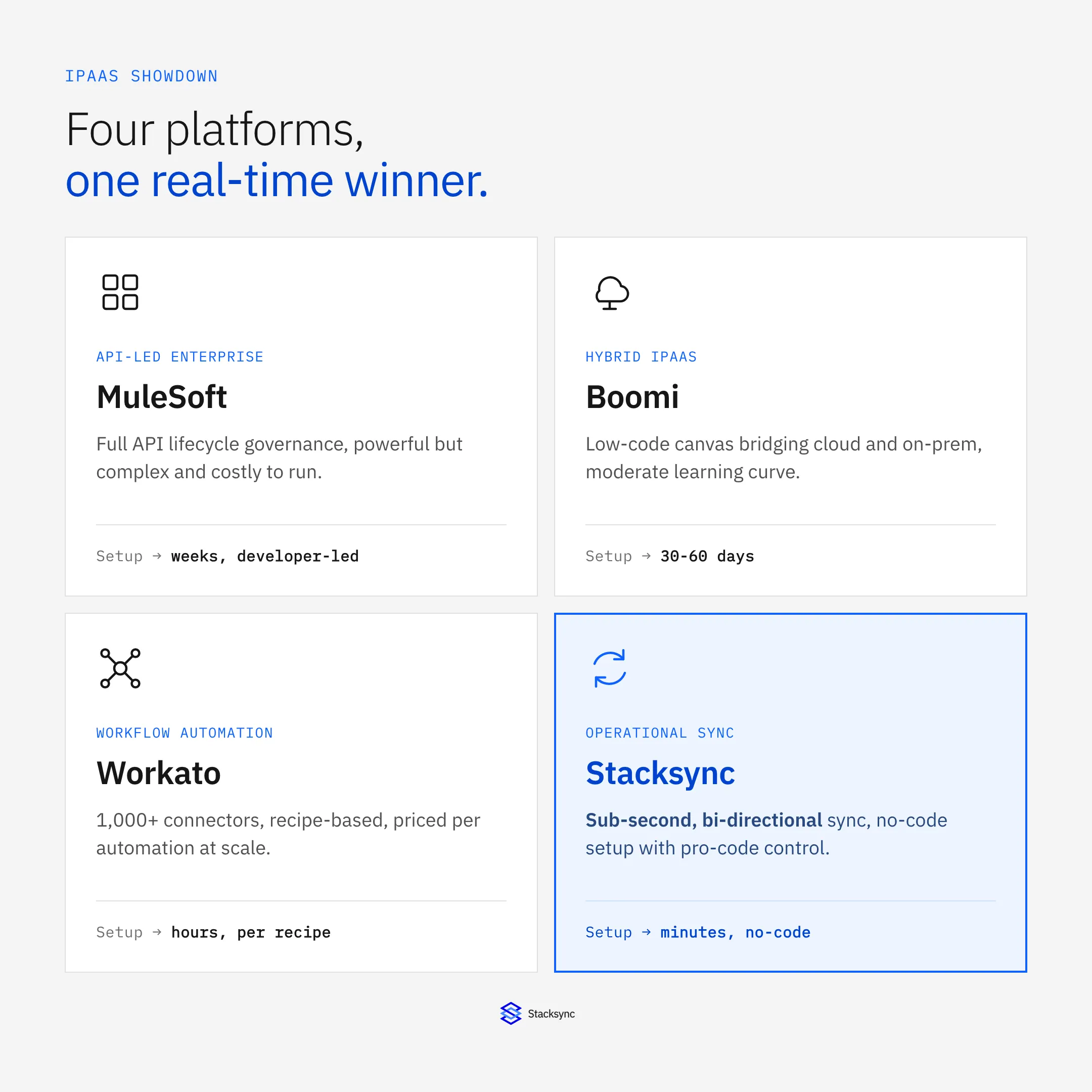
The iPaaS Leaders: A High-Level Overview
MuleSoft, Boomi, and Workato are powerful platforms, each with distinct strengths tailored to different integration philosophies and use cases.
MuleSoft Anypoint Platform
MuleSoft, a Salesforce company, champions an "API-led connectivity" approach. It is a comprehensive, hybrid integration platform designed for large enterprises building application networks.
Strengths: Excels in full lifecycle API management, deep feature coverage for complex enterprise needs, and strong integration with Salesforce and other legacy systems. It is well-suited for organizations that need to build, manage, and secure a large portfolio of APIs.
Weaknesses: The platform's power comes with a steep learning curve and complex pricing, often requiring specialized developers and significant investment. For teams focused purely on data synchronization, its extensive feature set can be excessive.
Boomi AtomSphere Platform
Boomi provides a unified, cloud-native iPaaS that uses a visual, low-code interface to connect applications and data across cloud and on-premises environments.
Strengths: Known for its scalability, mature data management, and strong support for legacy and on-premises systems through its enterprise service bus (ESB) architecture. It is a cost-effective alternative to MuleSoft for many enterprise use cases.
Weaknesses: Despite its visual interface, Boomi can be complex for new users to master. It has a steeper learning curve than some modern alternatives and certain restrictions on data filtering can create limitations.
Workato
Workato is a leader in enterprise automation, focusing on integrating applications and automating complex business workflows with a no-code/low-code interface.
Strengths: Highly regarded for its intuitive user experience, AI-driven guidance, and a vast library of pre-built connectors. It empowers both business and IT users to collaborate on building sophisticated process automations.
Weaknesses: Workato's pricing is based on the number of active automations ("recipes"), which can become expensive for high-volume or real-time synchronization tasks. It also lacks some out-of-the-box B2B/EDI features and has limitations on imported document sizes.
API Integration Capabilities: Connectors, Governance, and Custom Extensibility
Comparing these platforms on API integration capabilities means looking at three separate things: how many pre-built connectors ship out of the box, how the platform manages and governs APIs across their lifecycle, and what happens when a connector for your system does not exist.
- 01MuleSoft Anypoint Platform: Built around API-led connectivity with full lifecycle governance. Teams design APIs in RAML or the OpenAPI Specification, then enforce policies, rate limiting, and security through Anypoint Flex Gateway. This makes MuleSoft the strongest option when API governance across a large developer organization is the priority, at the cost of a steeper implementation curve.
- 02Boomi AtomSphere: Pairs its connector-based, low-code integration canvas with a built-in API Management module, so a data flow built visually can also be exposed as a managed API. Boomi's connector library covers common SaaS and ERP systems well, but its API governance tooling is less developer-centric than MuleSoft's.
- 03Workato: Ships more than 1,000 pre-built connectors on top of a recipe-based automation model. When a native connector does not exist, Workato's HTTP connector and an OpenAPI-based custom connector SDK let teams build one, though this shifts the work from no-code toward developer effort for edge cases.
- 04Stacksync: Instead of general-purpose API management, Stacksync ships pre-built bidirectional connectors for the systems most commonly kept in sync (Salesforce, HubSpot, NetSuite, PostgreSQL, MySQL, and more) plus a SQL-based interface and webhooks for custom logic. There is no API gateway to configure, since the sync engine handles field-level change detection and conflict resolution directly.
For a deeper breakdown of connector coverage and API extensibility specifically against Workato, see the full Workato alternative comparison.
Technical Comparison: iPaaS vs. Purpose-Built Sync
The fundamental difference between these platforms and a specialized tool emerges when examining their core architecture and intended use case.
| Feature | MuleSoft | Boomi | Workato | Stacksync |
|---|---|---|---|---|
| Core Architecture | API-Led Connectivity / ESB | Unified iPaaS / ESB | Workflow Automation Engine | Real-Time, Bi-Directional Sync Engine |
| Primary Use Case | Enterprise-wide application networks, API management | Hybrid (Cloud/On-Prem) integration, data management | Business process automation, workflow orchestration | Mission-critical operational data synchronization |
| Sync Model | Primarily scheduled, batch, or event-triggered one-way flows | Primarily scheduled or batch processing | Event-driven workflows, often simulating two-way sync | True bi-directional, real-time sync with conflict resolution |
| Latency | Minutes to hours, depending on configuration | Minutes to hours | Near real-time for workflows, but can vary | Sub-second |
| API Management | Full lifecycle governance (Anypoint Flex Gateway) | Built-in API Management module | OpenAPI custom connector SDK | Pre-built bidirectional connectors + SQL interface |
| Legacy System Support | Hybrid via Anypoint Runtime Fabric | On-prem Atom runtime, B2B/EDI | On-prem agent for COBOL, AS/400, DB2 | Direct SQL Server, Oracle, IBM AS/400 + SSH/VPN/VPC |
| Setup Complexity | High (Requires specialized developers) | Moderate to High (Steep learning curve) | Low to Moderate (Intuitive UI) | Low (No-code setup in minutes) |
| Ideal User | Enterprise Integration Architects, Developers | IT Integration Specialists | Business Technologists, IT Process Owners | Data Engineers, RevOps, Product Teams |
| Pricing Model | Complex, based on cores, APIs, and features | Complex, based on connectors and volume | Based on number of automations ("recipes") | Transparent, based on records in sync |
Legacy System Integration: Mainframes, AS/400, and On-Premise ERPs
Most enterprise integration projects still touch at least one system that predates the cloud, so it's worth comparing how each platform bridges legacy infrastructure with modern cloud services.
- 01MuleSoft: Supports hybrid and on-premise deployment through Anypoint Runtime Fabric, letting integration flows run inside a customer's own infrastructure while still being managed from the cloud control plane.
- 02Boomi: Uses a lightweight on-premise runtime called an Atom to connect legacy and on-prem systems, including B2B/EDI data flows, without exposing them directly to the public internet.
- 03Workato: Connects to legacy technologies such as COBOL applications, IBM AS/400, and DB2 databases through an on-premise agent, in addition to its cloud-native connectors.
- 04Specialist wrappers: Tools like OpenLegacy focus specifically on parsing mainframe and AS/400 code to auto-generate APIs, and are sometimes paired with a general-purpose iPaaS rather than replacing one.
- 05Stacksync: Connects directly to legacy databases (SQL Server, Oracle, IBM AS/400) and on-premise ERPs, with SSH tunneling, VPN connectivity, and VPC peering for systems behind a firewall, so legacy data can sync bidirectionally with modern cloud applications without a separate API-wrapping layer.
The Technical Deficit of General-Purpose iPaaS for Operational Sync
For use cases where data consistency directly impacts operations, such as syncing a Salesforce CRM with a PostgreSQL production database or a NetSuite ERP, the architectural choices of general-purpose iPaaS platforms create significant technical problems.
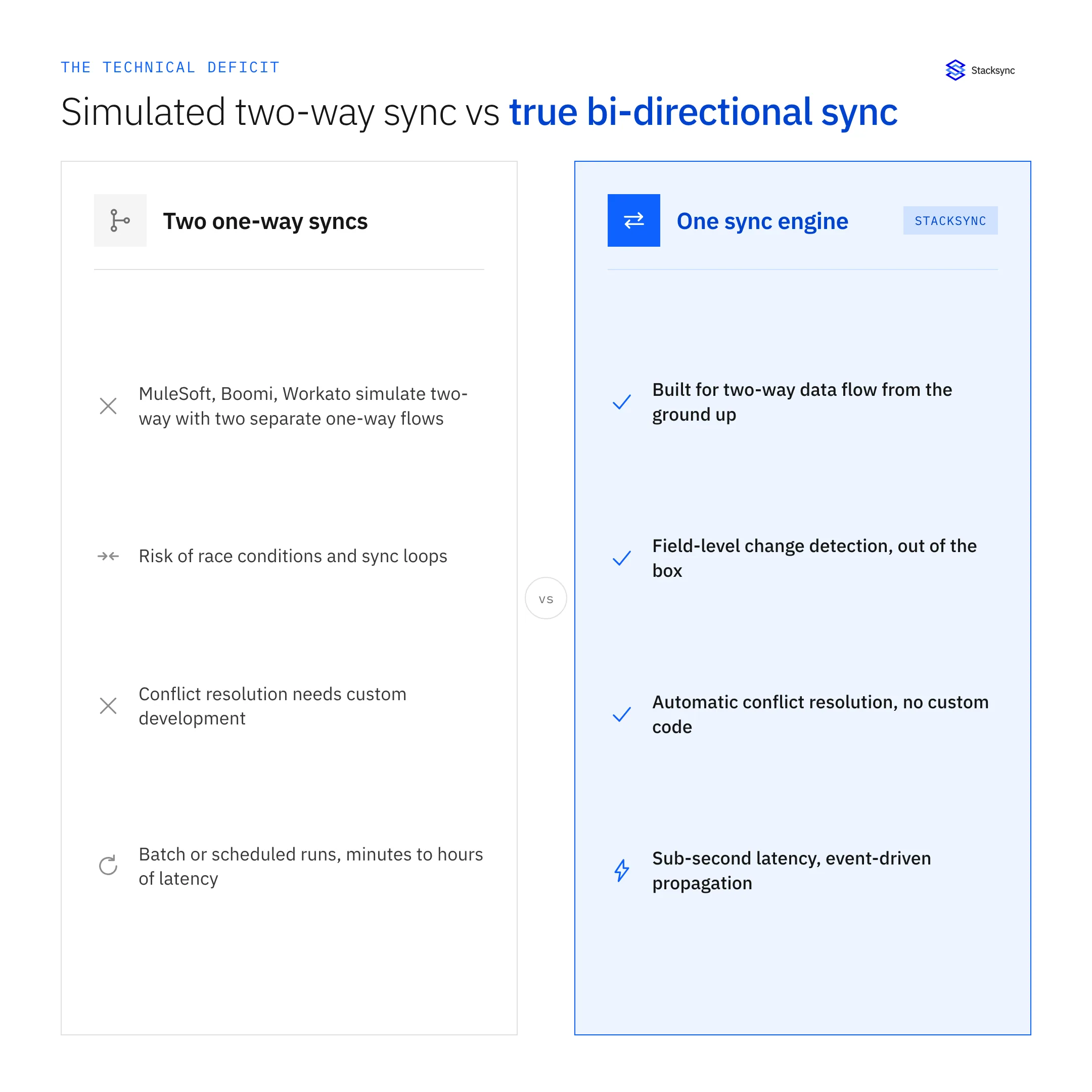
- 01The Illusion of Bi-Directionality: Most iPaaS platforms simulate two-way synchronization by configuring two separate one-way syncs. This approach can create a risk of race conditions, sync loops, and data overwrites. Implementing reliable conflict resolution logic often requires custom development and ongoing maintenance, which can reduce the benefits of a low-code platform.
- 02Latency: Operational decisions may require up-to-date data, but traditional iPaaS solutions often rely on batch or scheduled processes, resulting in latency that can be minutes to hours depending on configuration.
- 03Cost at Scale: Pricing models based on tasks, API calls, or number of automations are not designed for constant, high-volume data flow. As data volume grows, the cost of keeping systems in sync with platforms like Workato can escalate and become difficult to predict.
- 04Operational Complexity: These platforms are powerful but complex, often requiring specialized knowledge to configure, manage, and troubleshoot. This can divert engineering resources from core product development to integration maintenance.

Stacksync: Engineered for Real-Time, Bi-Directional Synchronization
The limitations of general-purpose iPaaS create a need for tools engineered specifically for operational data synchronization. Stacksync is designed to address this technical problem with a different architectural approach.
Instead of being a general-purpose integration platform, Stacksync focuses on providing real-time, bi-directional data consistency between operational systems.
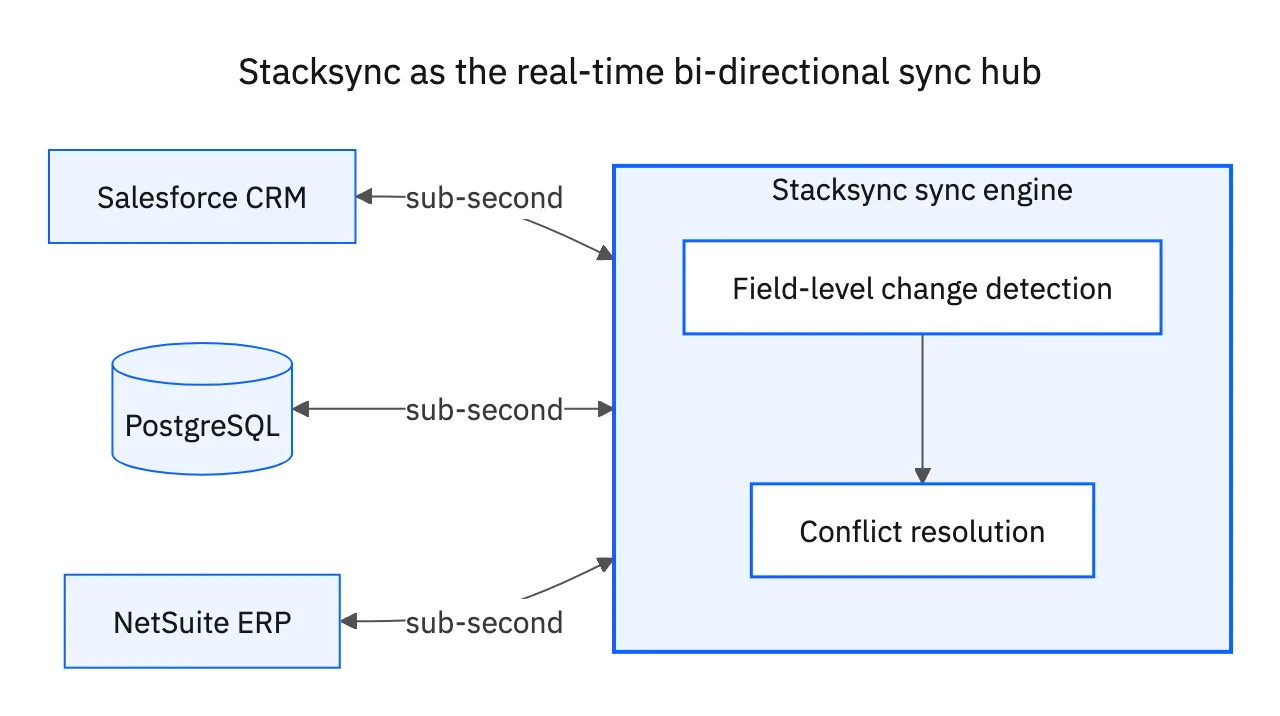
- Bi-Directional Sync Engine: Stacksync is built for two-way data flow, handling field-level change detection, referential integrity, and conflict resolution out of the box. This reduces the risk of sync loops and data corruption that can occur with simulated two-way syncs.
- Low Latency: The platform is designed for performance, propagating changes across systems with sub-second latency. This helps ensure teams are working from a consistent source of truth at all times.
- Scalability and Reliability: Stacksync is built to handle large data volumes without requiring users to manage infrastructure. Features like API rate limit management, a sync issue dashboard, event queues, and the ability to replay failed workflows support reliability and error handling.
- No-Code Simplicity with Developer Options: The platform can be set up quickly through a no-code interface, but also provides customization and a SQL-based interface for developers, allowing engineering teams to offload integration maintenance while retaining control and visibility.
Choosing the Right Tool for the Technical Job
The choice between these platforms depends on the specific technical requirements.
- Choose MuleSoft or Boomi when your primary challenge is orchestrating a complex, enterprise-wide application network that includes numerous legacy, on-premises systems and requires deep API lifecycle management. These are suitable when you have a dedicated integration team and the budget for a comprehensive platform.
- Choose Workato when your goal is to automate complex, multi-step business processes that span many applications. It excels at workflow orchestration where data movement is a step in a larger automated process, rather than the primary objective. See our full Workato alternative comparison for architecture and pricing details.
- Choose Stacksync when your primary technical requirement is guaranteed, real-time, bi-directional data consistency between your core operational systems (e.g., Salesforce <> PostgreSQL, HubSpot <> NetSuite, Zendesk <> MySQL). It is a strong choice when data integrity is critical, low latency is required, and you want to enable your engineering team to focus on innovation rather than integration maintenance.
For modern businesses that rely on real-time data, choosing a purpose-built synchronization platform like Stacksync can be a strategic technical decision that supports operational excellence and competitive advantage.

FAQ
Frequently asked questions




Related articles


