






Fivetran vs Airbyte vs Stitch: A Real-Time Sync Comparison
Fivetran vs Airbyte vs Stitch compared on connectors, latency, and pricing, plus why real-time two-way sync fits operational workflows that batch ELT can't.
- Author
- Ruben Burdin · Founder & CEO
- Published
- Updated
- Read time
- 6 min read

If you’re evaluating Stitch Data vs Airbyte or comparing them with Fivetran, the key question is simple: can they keep your operational systems in sync, in real time? The short answer is no. These tools excel at analytics pipelines but fail for real-time workflows. Here’s why Stacksync changes the game.
Each system becomes an isolated data silo, leading to inconsistencies, manual reconciliation, and a fractured view of the business.
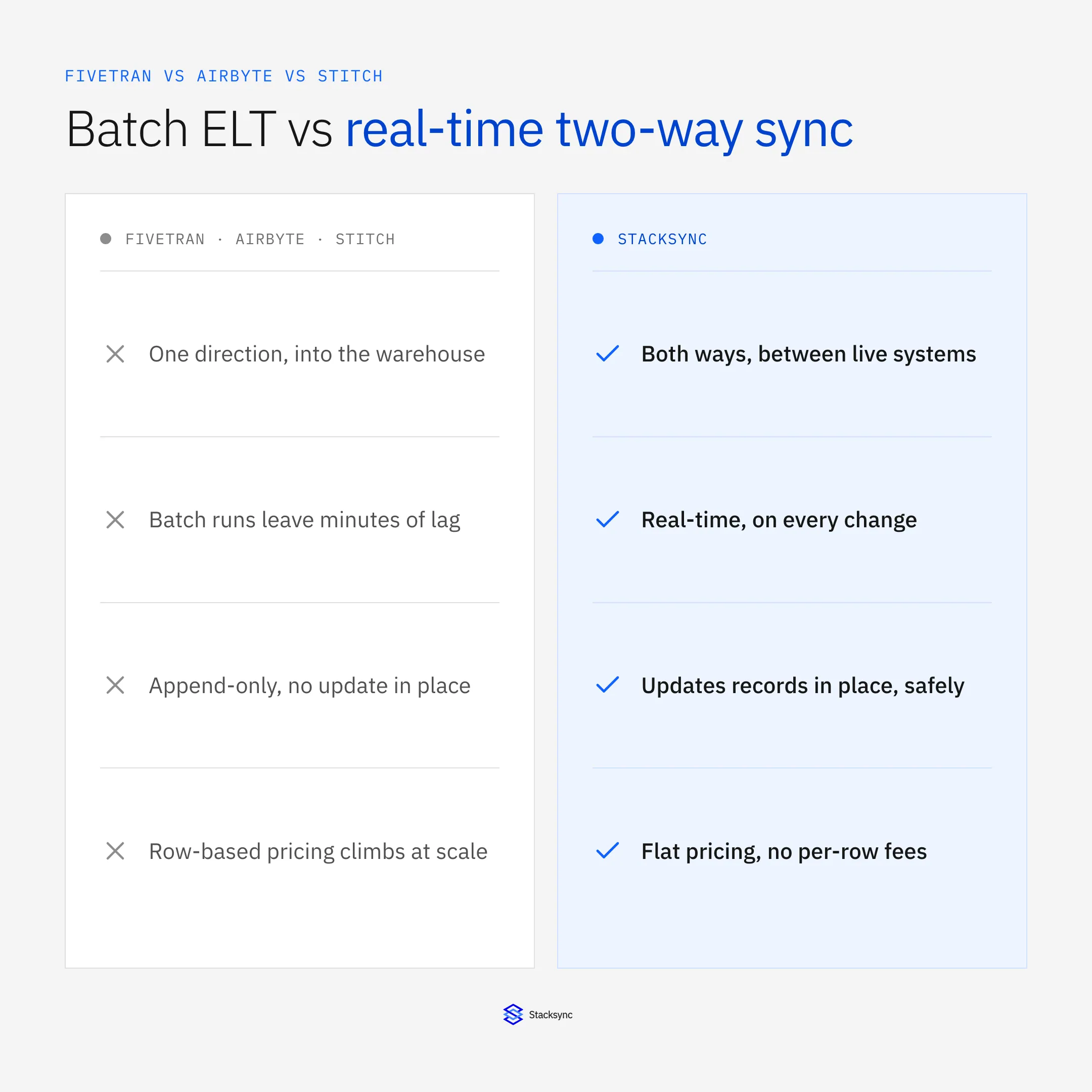
Data integration platforms like Fivetran, Airbyte, and Stitch emerged to address this by centralizing data for analytics. They excel at Extract, Load, Transform (ELT), moving data from various sources into a data warehouse. However, this one-way, batch-oriented model is fundamentally insufficient for modern operational needs.
Business processes cannot wait for the next batch run to get updated data. They require real-time, consistent data across all live systems, not just a delayed copy in a warehouse. This gap between analytics-focused data movement and operational data consistency is where traditional ELT tools fall short.
Analyzing the ELT Landscape: Fivetran, Airbyte, and Stitch
To understand the limitations, it's essential to analyze what these platforms were designed for. They are powerful tools for building analytics data pipelines, but their architecture reflects that specific purpose.
Fivetran: The Managed ELT Service
Fivetran is a fully managed, enterprise-grade platform known for its reliability and ease of use. It’s popular for analytics pipelines, but it falls short for real-time operations.
Technical Limitations:
- One-Way Architecture: Fivetran is built for one-way data flow and lacks native reverse ETL or bi-directional capabilities. It cannot keep two operational systems in sync.
- Latency: Sync frequencies are often restricted by pricing tiers, introducing latency that is unacceptable for real-time operational use cases.
- Cost at Scale: The pricing model, based on Monthly Active Rows (MAR), can become expensive for high-volume or frequently changing data.
- Inflexibility: The platform is closed-source, and the process for adding new connectors is slow and entirely dependent on Fivetran's internal roadmap.
Airbyte: The Open-Source Contender
Airbyte offers a flexible, developer-friendly, and often more cost-effective alternative, particularly when self-hosted. Its open-source nature has fostered a large community and an extensive library of connectors.
Technical Limitations:
- Batch Processing: Like Fivetran, Airbyte primarily uses batch processing and is append-only, meaning it loads new data but does not update records in place, which is a requirement for operational sync.
- Connector Reliability: A significant number of its connectors are community-supported. This can lead to inconsistent quality, making them brittle at scale and requiring significant engineering effort to maintain and debug.
- Operational Overhead: The flexibility of open-source comes with the cost of higher technical and maintenance overhead, especially for ensuring production-grade reliability.
- Unidirectional Focus: Airbyte is designed to consolidate data into warehouses, lakes, and databases; it is not architected for bi-directional, operational workflows.
Stitch Data: The Simplified ETL Tool
Stitch focuses on providing a simple, quick setup for data pipelines, using the open-source Singer standard for its connectors. It is designed for teams that need a straightforward way to move data for business intelligence without complex configurations.
Technical Limitations:
- Connector Quality Decline: Since its acquisition, the quality and maintenance of its connectors have reportedly declined. Only a small subset of connectors are actively maintained, making the platform less reliable for mission-critical data.
- Limited Customization: The platform is built for simplicity, which translates to limited options for customization, transformation, and support.
- Reliability Concerns: The combination of inconsistent connector quality and limited support makes Stitch a poor fit for use cases where data integrity and uptime are paramount.
The Operational Sync Gap: Beyond ELT
The core technical limitation of Fivetran, Airbyte, and Stitch is their architectural design. They are built for one-way data replication from sources to an analytical destination. They are not engineered to manage the complex, stateful, and real-time requirements of keeping operational systems synchronized with each other.
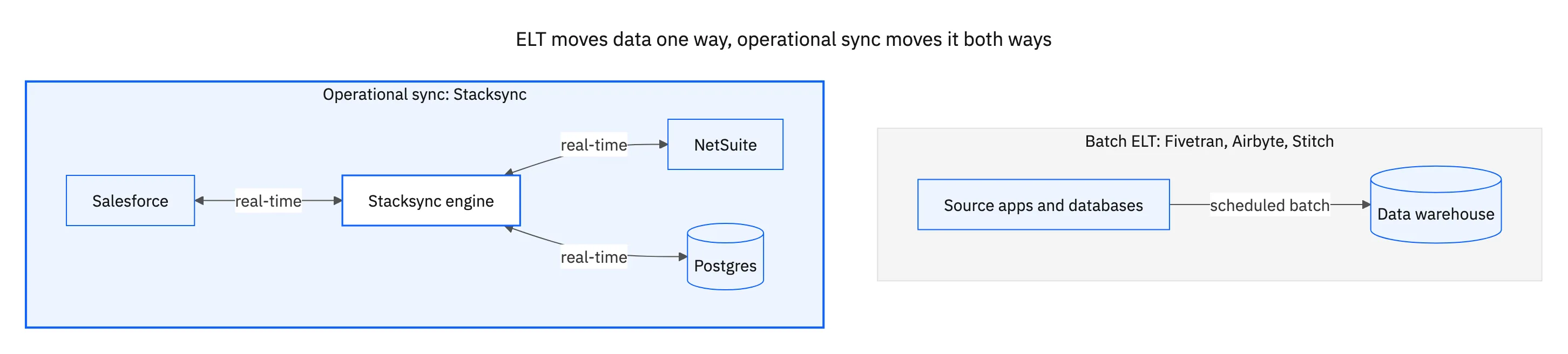
This architectural gap has direct business consequences:
- Data Latency: Sales teams work with customer data in the CRM that is out of sync with the financial data in the ERP.
- Operational Inefficiency: Support agents lack real-time order status from the backend database, leading to poor customer experiences.
- Manual Reconciliation: Engineering and operations teams spend valuable time manually correcting data inconsistencies between systems.
The market needs a new paradigm. The requirement is not just moving data to a warehouse (ELT) or from a warehouse (Reverse ELT). The critical need is for real-time, bi-directional synchronization between the live operational systems that run the business.
Stacksync: Purpose-Built for Real-Time Operational Sync
Stacksync is engineered from the ground up to solve this operational data consistency problem. It provides real-time, bi-directional synchronization that connects disparate enterprise systems into a cohesive, reliable data backbone.
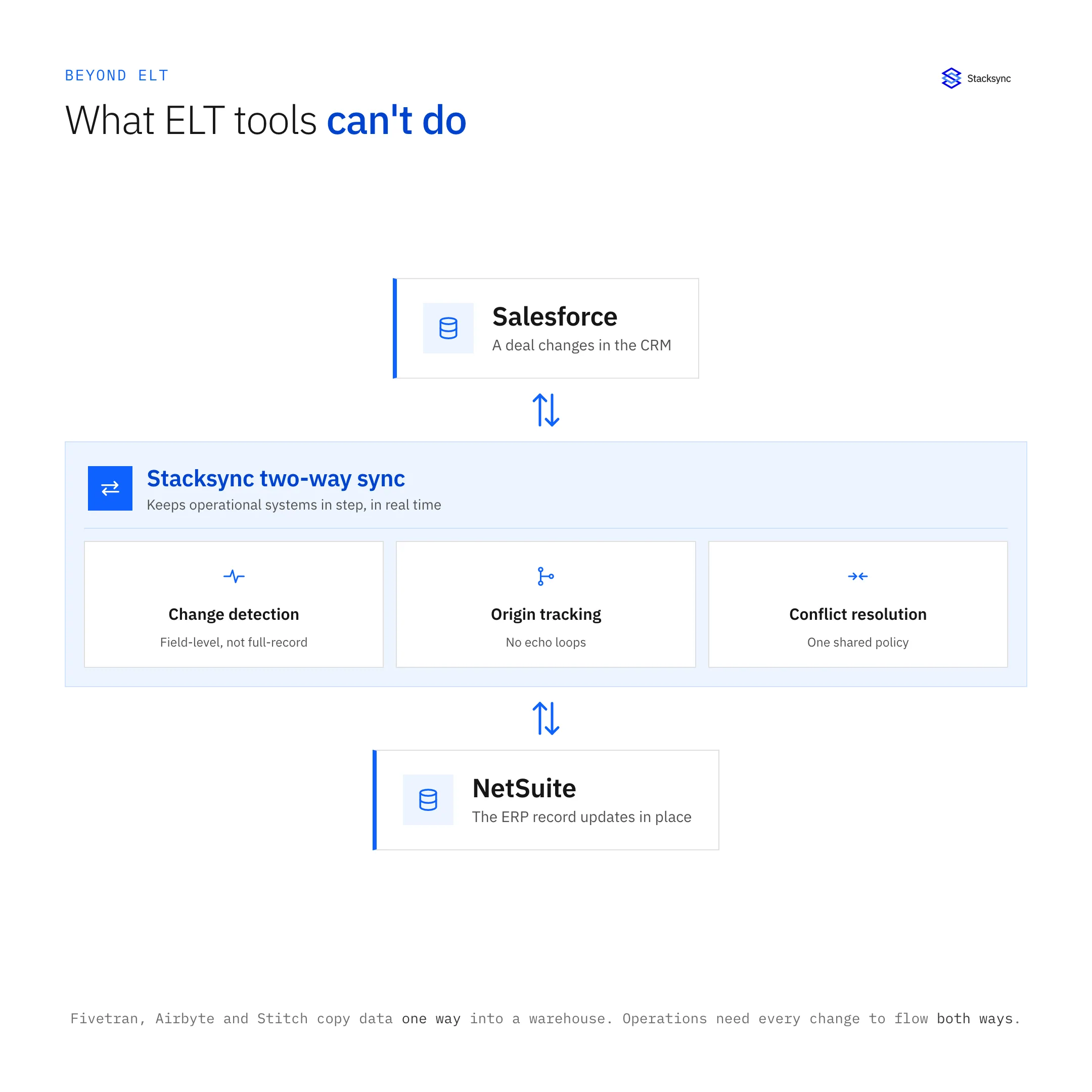
Where ELT tools stop, Stacksync begins. It is not another analytics pipeline tool; it is an operational enablement platform.
How Stacksync is Different
- True Bi-Directional Sync: Stacksync propagates changes instantly and bidirectionally between any two connected systems, such as Salesforce and NetSuite or HubSpot and PostgreSQL. This is not two one-way pipelines running in parallel; it is a single, cohesive engine with built-in conflict resolution to guarantee data integrity.
- Real-Time Performance: The platform operates with low latency, eliminating the data lag inherent in the batch-processing models of Fivetran and Airbyte. This is essential for operational workflows that depend on up-to-the-minute data for tasks like inventory management, order processing, and customer support.
- Operational Focus: Stacksync is designed to be the reliable data fabric for core business processes. It ensures that when a deal is updated in your CRM, the change is immediately and accurately reflected in your ERP, billing system, and customer support platform.
- Eliminating Complexity: With a no-code setup for a large number of enterprise-grade connectors, Stacksync removes the need for engineers to build and maintain brittle, custom API integrations. This directly addresses the maintenance burden of Airbyte's community connectors and the inflexibility of Fivetran's closed ecosystem.

Technical and Operational Benefits of Stacksync
By shifting from an analytics-focused ELT model to an operational sync model, organizations gain real technical and business benefits.
- Guaranteed Data Consistency: Remove data silos and establish a single, reliable source of truth across all operational tools, from your CRM to your production databases.
- Scalability without cost spikes: The architecture is built to handle millions of records without performance degradation or the unpredictable, escalating costs associated with the volume-based pricing of Fivetran and Airbyte.
- Automated Reliability: Stacksync is enterprise-ready with compliance features, resilient error handling, automated retries, and comprehensive monitoring. This ensures mission-critical syncs do not fail silently, a contrast to the inconsistent quality of Stitch and community-led Airbyte connectors.
- Empowering Engineering Teams: Free your developers from maintaining "dirty API plumbing." Stacksync serves as a powerful, reliable alternative to resource-intensive custom builds or complex iPaaS platforms, allowing your engineering talent to focus on building competitive advantage.
Conclusion: Choosing the Right Tool for the Job
Fivetran, Airbyte, and Stitch are effective tools for their intended purpose: populating data warehouses for analytics. They are masters of the ELT pipeline, and each earns a spot in our roundup of the best ETL tools.
However, for the operational challenges that define modern business, a different class of tool is required. When your goal is to ensure that your CRM, ERP, and databases are perfectly and perpetually in sync in real-time, the limitations of the ELT model become a critical bottleneck.
Stacksyncis a solution for this operational synchronization layer. By providing bi-directional, real-time sync with enterprise-grade reliability and a no-code setup, Stacksync empowers organizations to move beyond analytics pipelines and build a truly connected, efficient, and resilient operational data backbone.

FAQ
Frequently asked questions




Related articles


