





Postgres Change Data Capture: Speed, Cost, Complexity Showdown
Discover Stacksync's Postgres CDC solution: sub-second bi-directional sync for real-time data consistency without traditional complexity or high costs.
- Author
- Ruben Burdin · Founder & CEO
- Published
- Updated
- Read time
- 9 min read

Modern enterprises face a critical operational challenge: maintaining real-time data consistency across specialized systems while avoiding the complexity and costs of traditional CDC implementations. Postgres CDC provides a method to share change events from Postgres tables without affecting database performance, leveraging logical decoding to extract information from the Write-Ahead Log (WAL) [1][2].
However, most CDC solutions force organizations into an impossible choice between operational speed, implementation complexity, and budget constraints. Traditional platforms like Debezium demand Kafka expertise, hosted solutions impose enterprise-level costs, and ETL providers introduce unacceptable latency for operational systems.
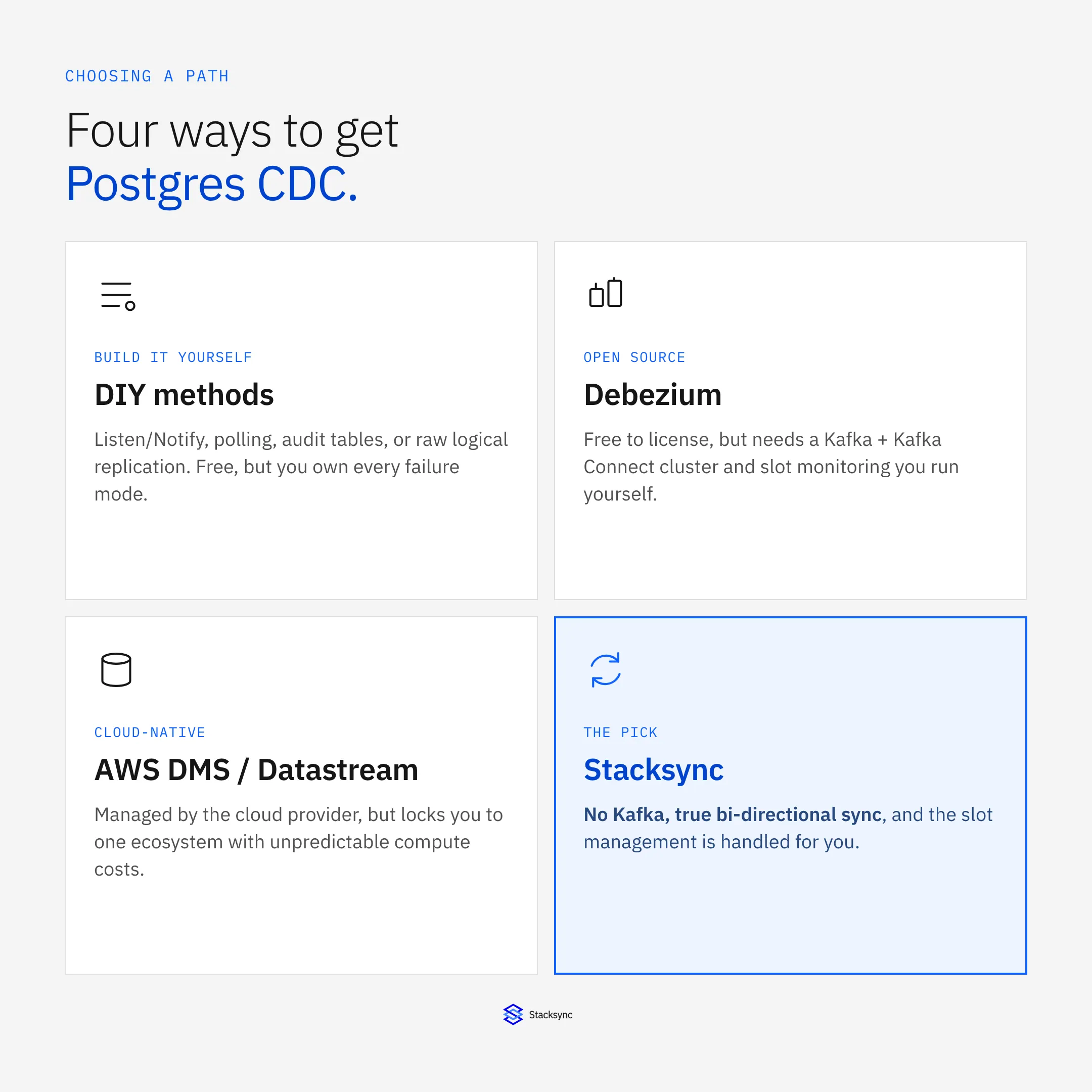
Stacksync eliminates these trade-offs through purpose-built bi-directional synchronization that delivers sub-second data consistency across CRMs, ERPs, and databases without the infrastructure overhead of traditional CDC platforms.
The Operational CDC Problem
Change data capture extracts record-level change events (INSERTs, UPDATEs, and DELETEs) from PostgreSQL in real-time, enabling fully event-driven data architectures that keep downstream systems always in sync [3]. Yet traditional CDC solutions fail operational requirements in three critical areas:
Latency and Reliability Issues
Most CDC platforms prioritize analytics over operations, introducing batch processing delays and one-way data flows that break real-time operational workflows.
Infrastructure Complexity
Traditional solutions require specialized streaming expertise, complex Kafka deployments, and dedicated engineering resources for maintenance.
Cost Inefficiency
Enterprise CDC platforms impose high licensing costs while demanding additional infrastructure investments, making them prohibitively expensive for mid-market organizations.
Build-Your-Own CDC Methods (and Why Teams Outgrow Them)
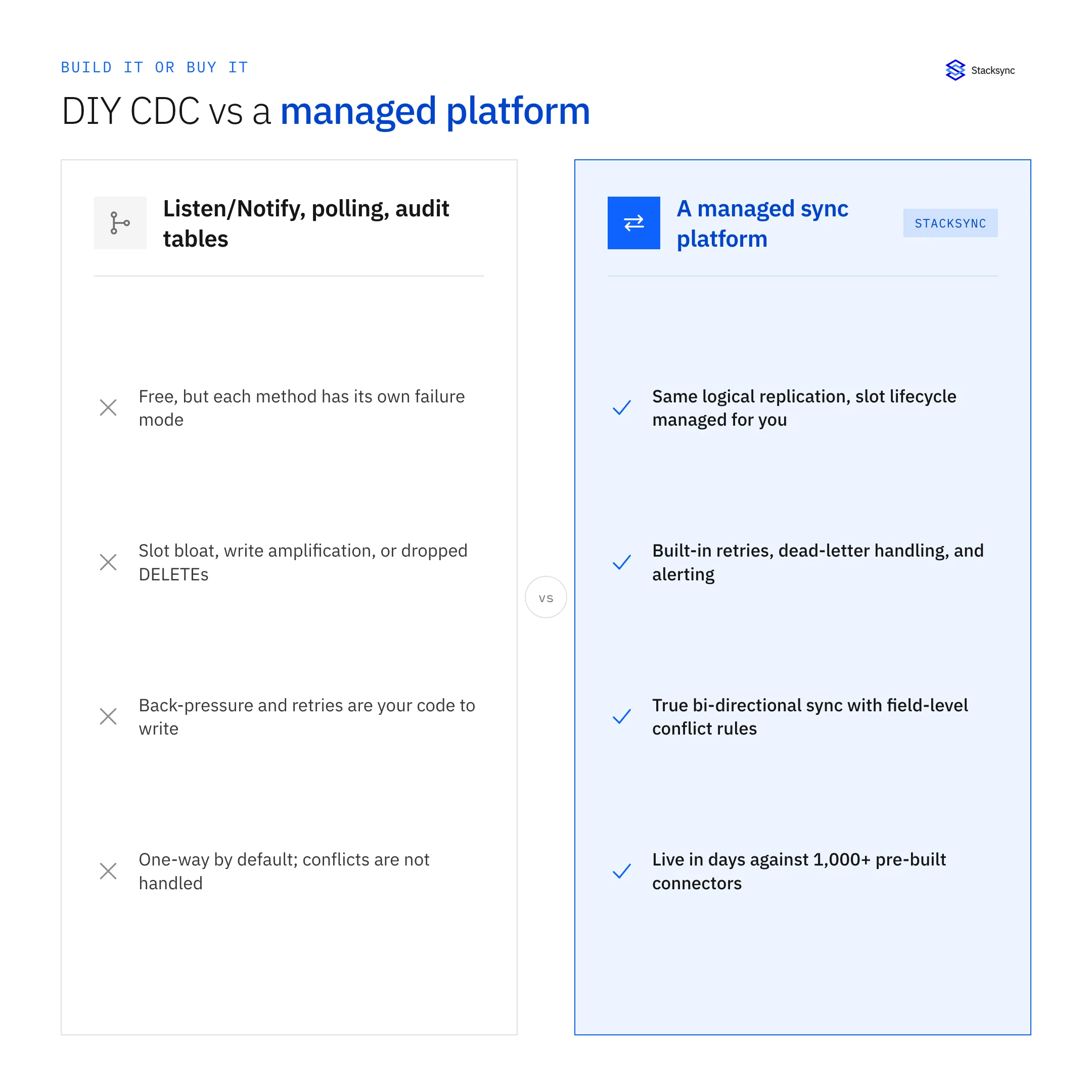
Before evaluating vendors, most teams try to build change capture directly on PostgreSQL. Each method below is real and works, but each hits a specific wall in production.
Listen/Notify
CREATE OR REPLACE FUNCTION notify_trigger() RETURNS TRIGGER AS $$
DECLARE payload json;
BEGIN
  payload := json_build_object('table', TG_TABLE_NAME, 'id', NEW.id, 'action', TG_OP);
  PERFORM pg_notify('table_changes', payload::text);
  RETURN new;
END;
$$ LANGUAGE plpgsql;

CREATE TRIGGER my_trigger
AFTER INSERT OR UPDATE OR DELETE ON my_table
FOR EACH ROW EXECUTE FUNCTION notify_trigger();
At-most-once delivery, an 8,000-byte payload limit, and no durability if the listener is offline. Suits low-stakes change notifications, not operational sync.
Timestamp Polling
SELECT * FROM public.users
WHERE updated_at > 'TIMESTAMP_LAST_QUERY'
ORDER BY updated_at, id;
Cannot capture DELETEs without soft deletion, adds recurring query load, and out-of-order commits on the timestamp column can silently skip records.
Audit Table Pattern
CREATE OR REPLACE FUNCTION changelog_trigger() RETURNS TRIGGER AS $$
DECLARE
  action text; table_name text; transaction_id bigint; ts timestamp;
  old_data jsonb; new_data jsonb;
BEGIN
  action := lower(TG_OP::text);
  table_name := TG_TABLE_NAME::text;
  transaction_id := txid_current();
  ts := current_timestamp;
  IF TG_OP = 'DELETE' THEN old_data := to_jsonb(OLD.*);
  ELSIF TG_OP = 'INSERT' THEN new_data := to_jsonb(NEW.*);
  ELSIF TG_OP = 'UPDATE' THEN old_data := to_jsonb(OLD.*); new_data := to_jsonb(NEW.*);
  END IF;
  INSERT INTO changelog (action, table_name, transaction_id, timestamp, old_data, new_data)
  VALUES (action, table_name, transaction_id, ts, old_data, new_data);
  RETURN null;
END;
$$ LANGUAGE plpgsql;

-- Consumer side, processed with FOR UPDATE SKIP LOCKED to avoid double-processing
BEGIN;
SELECT * FROM changelog ORDER BY timestamp LIMIT 100 FOR UPDATE SKIP LOCKED;
DELETE FROM changelog WHERE id IN (list_of_processed_record_ids);
COMMIT;
Captures full before/after state including DELETEs, but every write becomes two writes, and back-pressure (a slow consumer letting the changelog table balloon) is entirely the team's problem to manage.
Logical Replication
SELECT * FROM pg_create_logical_replication_slot('your_slot_name', 'pgoutput');
The same mechanism Debezium and Stacksync both use under the hood. It is the most complete method, but the replication slot accumulates WAL the moment it exists, and a consumer that stops reading (crashes, gets redeployed, falls behind) can fill the disk before anyone notices. See our logical decoding plugins guide for pgoutput vs wal2json output formats, and watermark coordination for running a backfill alongside a live slot without duplicating or dropping rows.
Foreign Data Wrappers
FDWs let a trigger write directly into a foreign table on another Postgres instance, which works for narrow database-to-database sync but couples the two databases transactionally: a rejected write on the foreign side rolls back the local transaction too.
Each of these methods is a legitimate starting point. What breaks them at scale is the same thing across all five: someone has to own slot monitoring, back-pressure, retries, and schema drift by hand. That operational ownership is what the vendors below (and Stacksync) are actually selling.
Stacksync: Purpose-Built Operational Synchronization
Stacksync addresses operational CDC challenges through a fundamentally different approach: true bi-directional synchronization with enterprise-grade reliability and zero infrastructure complexity.
Technical Superiority
Changes: Real-time logical replication with field-level change detection and instant bi-directional propagation
Guarantees: Exactly-once processing with native conflict resolution and automated error handling
Destinations: 1,000+ pre-built connectors spanning CRMs (Salesforce, HubSpot), ERPs (NetSuite, SAP), databases (PostgreSQL, MySQL, Snowflake), and streaming platforms
Operational Excellence
Unlike traditional CDC tools, Stacksync operates through your existing database infrastructure, with no Kafka clusters, no streaming platform expertise, no infrastructure maintenance. Changes propagate with sub-second latency while maintaining absolute data consistency across all connected systems.
Enterprise-Ready Security
SOC 2 Type II, GDPR, HIPAA BAA, ISO 27001, and CCPA compliance ensure enterprise security standards without additional configuration overhead.
Proven ROI
Customer implementations demonstrate measurable operational improvements:
- Acertus: $30,000+ annual savings replacing Heroku Connect while improving real-time data availability
- Complete7: 50% faster IoT data updates with 40% less manual intervention
- Nautilus Solar: Seamless multi-system integration with automated workflow capabilities
Traditional CDC Platform Analysis
Free, Open Source Solutions
Debezium
Technical Assessment:
- Changes: Logical replication with inserts, updates, and deletes streaming to Apache Kafka [4]
- Guarantees: Exactly-once processing through Kafka's distributed architecture
- Destinations: Kafka topics only, requiring additional Connect framework
Implementation Complexity: Very High. Demands expertise in JVM, ZooKeeper, and Kafka management. Requires understanding esoteric PostgreSQL concepts like replication slots and logical decoding [1].
Budget Impact: High total cost of ownership despite free licensing, with significant engineering overhead for deployment and maintenance.
Assessment: Powerful but notoriously complex, requiring specialized Kafka expertise that diverts engineering resources from core business development. For the mechanics of how Debezium reads the WAL, and a practical migration path off it, see our Debezium deep dive. Teams that want a Kafka-free queue built directly on Postgres can also build an SQS- or Kafka-like queue in raw SQL.
Hosted Commercial Platforms
Confluent
Technical Assessment:
- Enterprise Debezium with managed infrastructure
- Exactly-once processing with enhanced monitoring
- Kafka ecosystem with extensive Connect framework
Implementation Complexity: Medium. Eliminates infrastructure management but requires deep Kafka configuration knowledge.
Budget Impact: Very high enterprise licensing with per-connector pricing plus Kafka infrastructure costs.
Assessment: Expensive enterprise solution that still demands Kafka expertise for configuration and maintenance.
Striim
Technical Assessment:
- Real-time change capture with enterprise transformations
- Exactly-once processing with comprehensive security features
- Multiple enterprise destinations with built-in connectivity
Implementation Complexity: Medium. Proprietary TQL language and StreamApps framework require platform-specific learning.
Budget Impact: Very high. All-in enterprise contracts designed for Fortune 1,000 companies.
Assessment: Enterprise-grade reliability but prohibitive costs and vendor-specific expertise requirements.
Cloud Provider Tools
AWS DMS, GCP Datastream, Azure Data Factory
Technical Assessment:
- Cloud-native logical replication with provider integration
- Variable guarantees depending on configuration
- Limited to respective provider ecosystems
Implementation Complexity: Medium. Requires navigating complex provider-specific interfaces and service configurations.
Budget Impact: Medium to high with unpredictable costs from compute, data transfer, and service dependencies. AWS DMS alone starts around $70/month for a replication instance before storage and data-transfer charges.
Assessment: Viable for single-provider environments but creates vendor lock-in with complex pricing models.
Postgres-Native CDC Startups
Sequin, Estuary Flow, Decodable, PeerDB
Technical Assessment: A newer generation of tools built specifically around Postgres logical replication, positioned as lighter-weight than Debezium's Kafka-centric model. Sequin and PeerDB in particular market themselves on avoiding a separate Kafka cluster.
Assessment: Worth evaluating for teams that want log-based CDC without Kafka but don't need bi-directional operational sync; each has a narrower connector footprint than an operational sync platform or the big ETL vendors.
ETL Platform Limitations
Fivetran, Airbyte, Stitch
These platforms excel at analytics workflows but fail operational requirements:
Operational Inadequacy: Mature solutions for one-way data replication to data warehouses for analytics and BI , but batch processing delays and unidirectional data flow prevent real-time operational synchronization.
Latency Issues: Processing delays from minutes to hours make them unsuitable for mission-critical operational systems requiring immediate data consistency.
Assessment: Analytics-focused tools that cannot meet operational CDC demands for real-time bi-directional data consistency.
Why Stacksync Eliminates Traditional Trade-offs
True Bi-Directional Architecture
Stacksync provides genuine bi-directional synchronization, not dual one-way connections, with intelligent conflict resolution ensuring data integrity across all connected systems. Changes in Salesforce instantly appear in PostgreSQL and vice versa, maintaining operational consistency without manual intervention.
Database-Centric Simplicity
By leveraging existing PostgreSQL infrastructure, Stacksync eliminates streaming platform complexity entirely. No Kafka clusters, no specialized expertise, no infrastructure maintenance, just reliable, real-time synchronization through familiar database interfaces.
Enterprise Operational Focus
Unlike analytics-oriented platforms, Stacksync prioritizes operational system reliability. Mission-critical business processes depend on immediate data consistency, and Stacksync delivers sub-second latency with exactly-once processing guarantees.
Proven Customer Success
Real implementations demonstrate Stacksync's operational superiority:
- Engineering Efficiency: Teams eliminate months of custom integration development, focusing resources on competitive differentiation
- Cost Reduction: Organizations achieve 90% cost reductions compared to traditional integration approaches
- Operational Reliability: Automated error handling and conflict resolution ensure consistent data across all systems

Implementation Decision Framework
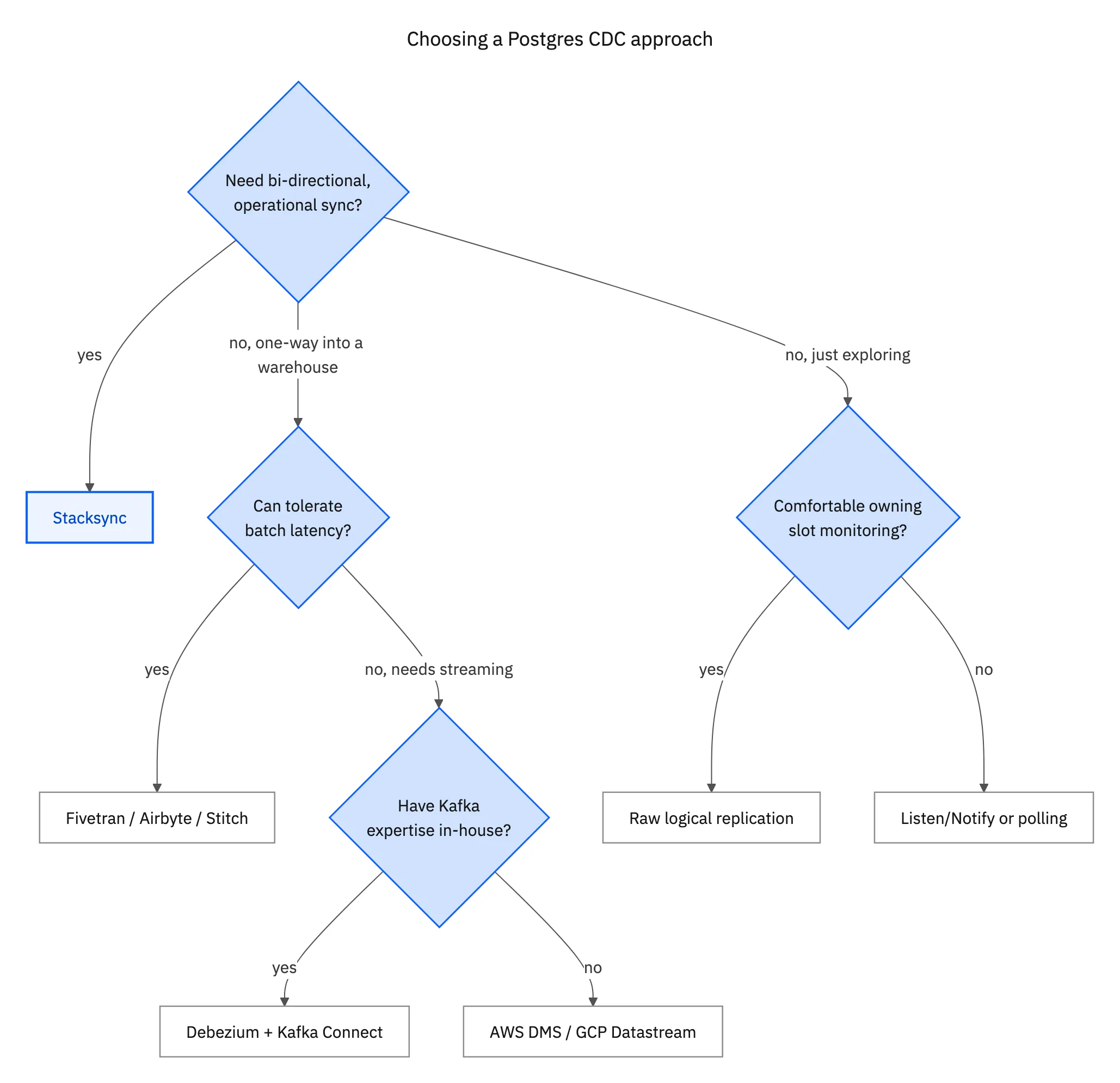
Choose Traditional CDC When:
- Analytics workflows can tolerate batch processing delays
- Engineering team possesses deep Kafka and streaming expertise
- Existing Kafka infrastructure investment requires leveraging
Choose Stacksync When:
- Operational systems require real-time, bi-directional data consistency
- Engineering resources should focus on core business development
- Implementation speed and total cost of ownership are priorities
- Enterprise-grade reliability without infrastructure complexity is essential
- Multiple system integration demands unified data management
Conclusion
The Postgres CDC landscape forces organizations to choose between operational capability, implementation complexity, and cost efficiency. Traditional solutions demand specialized streaming expertise while failing to address real-time operational requirements through bi-directional synchronization.
Stacksync represents the evolution beyond traditional CDC limitations, providing enterprise-grade bi-directional synchronization through existing database infrastructure. With 1,000+ connectors, SOC 2 compliance, and proven customer success delivering $30,000+ annual savings, Stacksync enables organizations to achieve operational data consistency without sacrificing engineering resources or budget efficiency.
For operational systems requiring immediate data consistency, automated data sync between applications, and enterprise data integration capabilities without traditional CDC complexity, Stacksync delivers the reliability and simplicity that modern businesses demand.
Transform your operational data architecture from complex CDC management to seamless bi-directional synchronization. Experience Stacksync's operational advantage and discover how purpose-built synchronization eliminates traditional trade-offs while ensuring enterprise-grade reliability.

FAQ
Frequently asked questions




Related articles


